Archivo de la categoría: Publications

NEW PUBLICATION IN SCIENCE OF THE TOTAL ENVIRONMENT

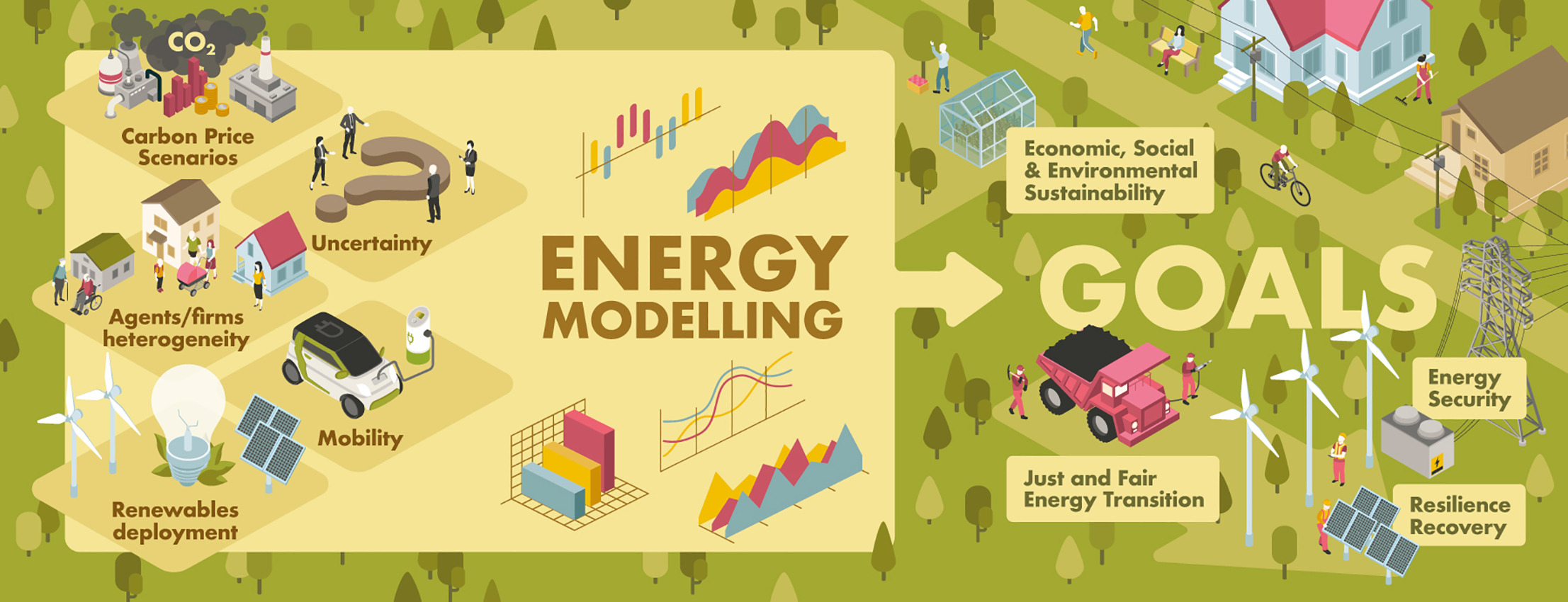
The Science Network RED MENTES has recently published a joint contribution entitled “Energy-socio-economic-environmental modelling for the EU energy and post-COVID-19 transitions” in the journal Science of the Total Environment.

The paper argues how recovery plans are an opportunity to deepen the way towards a low-carbon economy, improving at the same time employment, health, and equity and the role of modelling tools. It is based on contributions from many network members and tries to justify how multidisciplinary modeling is key to the successful development of the energy transition. Policies must be focused on both short-term and long-term goals, and the assessment of the social impacts of the energy transition must be highlighted. The scientific community has to assess disparate, non-equilibrium, and non-ordinary scenarios, such as sectors and countries lockdowns, drastic changes in consumption patterns, significant investments in renewable energies, and disruptive technologies, and incorporate uncertainty analysis

This paper has been written by Ignacio Cazcarro, Diego García-Gusano,  Diego Iribarren, Pedro Linares José Carlos Romero, Pablo Arocena, Iñaki Arto, Santacruz Banacloche, Yolanda Lechón, Luis Javier Miguel, Jorge Zafrilla, Luis-Antonio López, Raquel Langarita y María-Ángeles Cadarso, from ARAID and University of Zaragoza, Tecnalia, IMDEA, Comillas Pontificial  University, Public University of Navarra, Basque Centre for Climate Change (BC3), CIEMAT, University of Valladolid and University of Castilla-La Mancha.

Read us at: https://www.sciencedirect.com/science/article/pii/S0048969721054061

NEW PUBLICATION in Renewable and Sustainable Energy Reviews

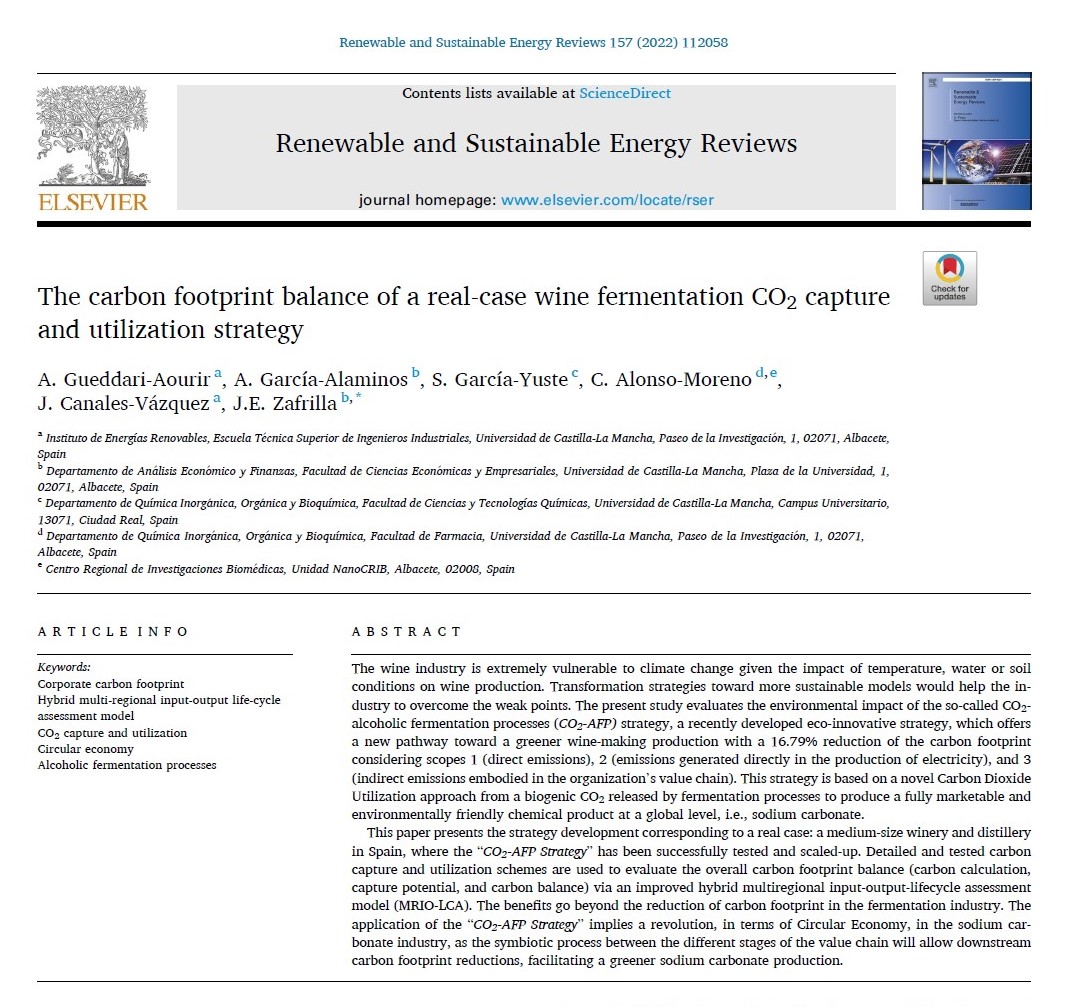
UCLM researchers Abdessamad Gueddari-Aourir, Santiago García-Yuste, Carlos Alonso-Moreno, and Jesús Canales-Vázquez together with the GEAR Group members Ángela García-Alaminos and Jorge Zafrilla have recently published a new research article in Renewable and Sustainable Energy Reviews.

The paper, entitled “The carbon footprint balance of a real-case wine fermentation CO2 capture and utilization strategy”, evaluates the environmental impact of the so-called CO2-alcoholic fermentation processes (CO2-AFP) strategy, a recently developed eco-innovative strategy. This proposal offers a new pathway toward a greener wine-making production with a 16.79% reduction of the carbon footprint considering scopes 1 (direct emissions), 2 (emissions generated directly in the production of electricity), and 3 (indirect emissions embodied in the organization’s value chain). The paper presents the strategy development corresponding to a real case: a medium-size winery and distillery in Spain, where the “CO2-AFP Strategy” has been successfully tested and scaled up. Detailed and tested carbon capture and utilization schemes are used to evaluate the overall carbon footprint balance (carbon calculation, capture potential, and carbon balance) via an improved hybrid multiregional input-output-lifecycle assessment model (MRIO-LCA). The benefits go beyond the reduction of carbon footprint in the fermentation industry. The application of the “CO2-AFP Strategy” implies a revolution, in terms of Circular Economy, in the sodium carbonate industry, as the symbiotic process between the different stages of the value chain will allow downstream carbon footprint reductions, facilitating a greener sodium carbonate production.

We hope you enjoy it!    LINK

New chapter published

Sustainability and resilience in tourism through carbon footprint assessment

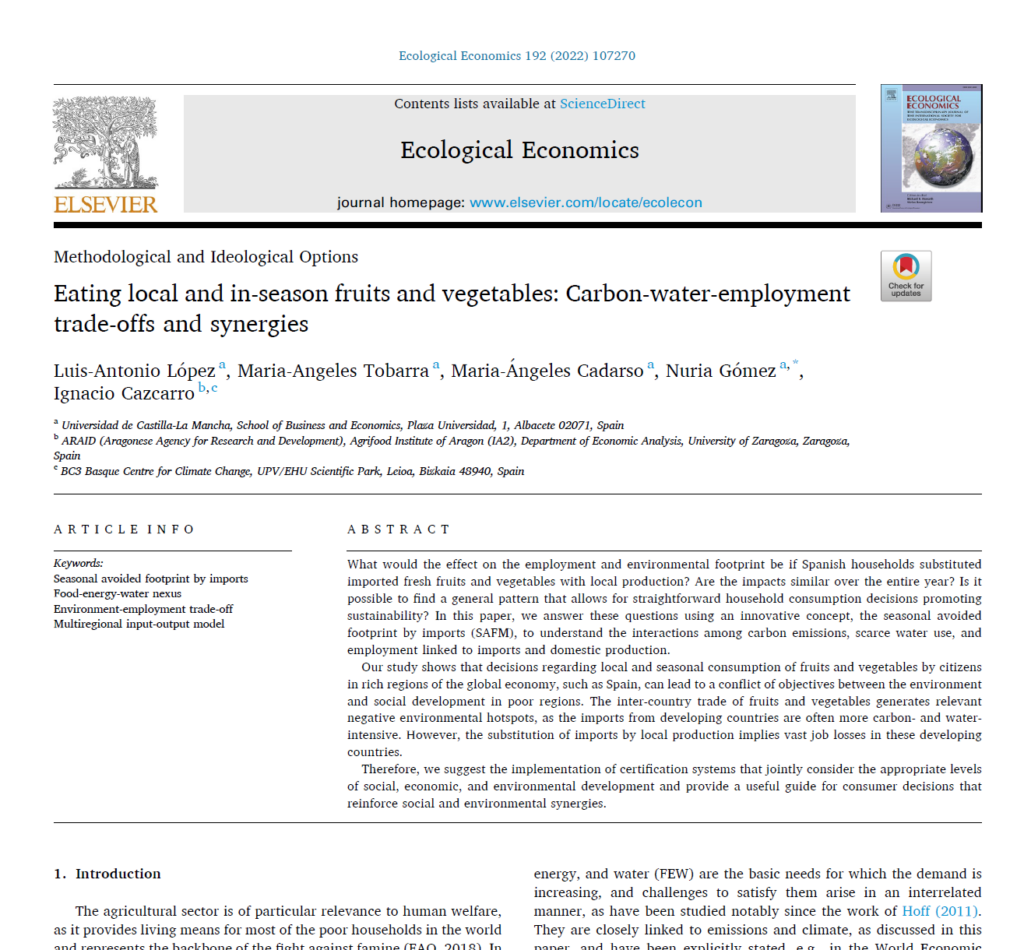
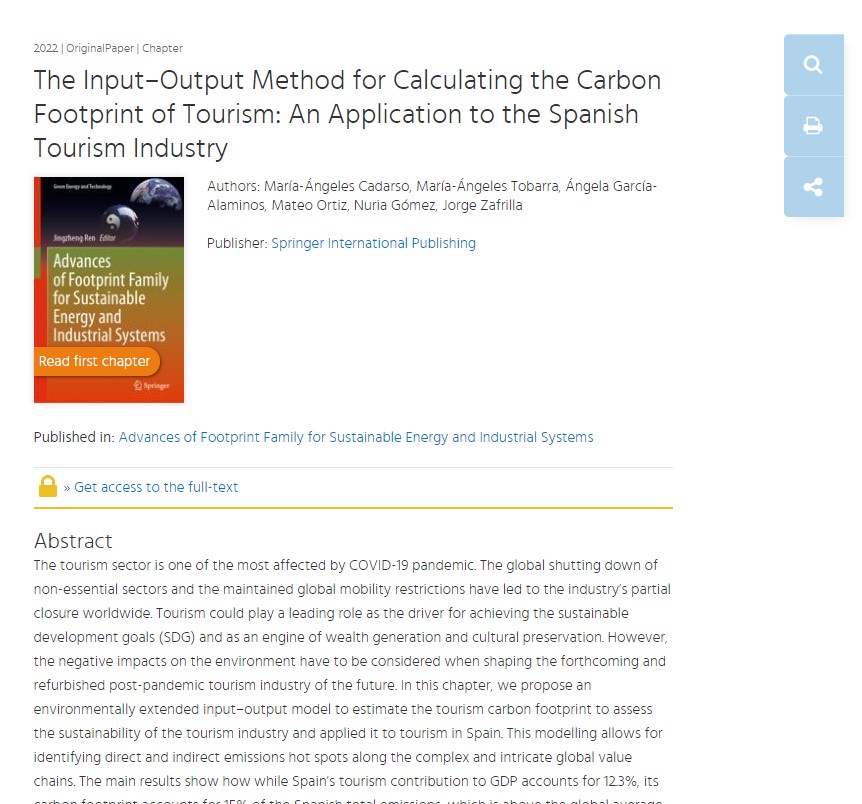
GEAR Members María Ángeles Cadarso, María Ángeles Tobarra, Ángela García-Alaminos, Mateo Ortiz, Nuria Gómez, and Jorge Zafrilla have recently published a new book chapter entitled “The Input–Output Method for Calculating the Carbon Footprint of Tourism: An Application to the Spanish Tourism Industry” inside the book Advances of Footprint Family for Sustainable Energy and Industrial Systems, edited by  J. Ren in the Green Energy and Technology Series in Springer International Publishing.

Tourism is an activity that represents a high share in GDP and employment in developed economies as the Spanish one (in which tourism contribution to GDP accounts for 12.3%), but also in developing areas. However, the sustainability of such activity is controversial because it is highly pollutant given its transport dependency. The pandemic crisis has struck tourism heavily, showing its high vulnerability too. Its recovery in the new normality shouldn’t constitute a return to the pre-pandemic situation, instead, it should be regarded as a chance to turn into a more sustainable and resilient activity. In this sense, this chapter calculates the carbon footprint of tourism for the Spanish economy in a pre-covid context and proposes it as a measure to evaluate monitor and establish strategies towards the reduction of the environmental impact of tourism.

The main results show that the carbon footprint of tourism in Spain accounts for 15% of the Spanish total emissions, which is above the global average (8%). In global terms, 29% of the total carbon footprint is imported, so it is, directly or indirectly, embodied in the global production chains. It is concentrated in some close European Union countries, China, BRIIAT, and the United States. At a sectoral level, the Spanish tourism carbon footprint is concentrated in some industries where emissions are mostly domestic (air transport, land transport, or retail trade).

We invite you to have a look at the chapter in this link: https://www.springerprofessional.de/en/the-input-output-method-for-calculating-the-carbon-footprint-of-/19368472

NEW PUBLICATION IN SERIES – JOURNAL OF THE SPANISH ECONOMIC ASSOCIATION

Santiago J. Rubio from the University of Valencia and GEAR Group member Ángela García-Alaminos have recently published a new research article entitled “Emission taxes and feed-in subsidies in the regulation of a polluting monopoly” in SERIEs – Journal of the Spanish Economic Association.

The paper studies and compares the use of emission taxes and feed-in subsidies for the regulation of a monopoly that can produce the same good with a technology that employs a polluting input and a clean technology. First, it is showed that the efficient solution could be implemented combining a tax on emissions and a subsidy on clean output. The second-best tax and subsidy are also calculated through a two-stage policy game between the regulator and the monopoly, concluding that the second-best tax rate can be the Pigouvian tax, but only if the marginal costs of the clean technology are constant. A linear-quadratic specification of the model is also developed, allowing for a comparison of both policy instruments.

This work was awarded the “Young Researcher in Energy Economics Prize» by Red Eléctrica de España and the Spanish Association for Energy Economics in January 2020.

We hope you enjoy it!

ACCESS TO FULL PAPER: LINK

NEW PUBLICATION IN ECONOMIC SYSTEMS RESEARCH

GEAR Group members Ángela García-Alaminos, Mateo Ortiz, Guadalupe Arce, and Jorge Zafrilla have recently published a new research article in Economic Systems Research.

The paper, entitled “Reassembling social defragmented responsibilities: the indecent labour footprint of US multinationals overseas”, presents news insights about the social impacts embodied in multinational firms’ global value chains.  Combining a  socially extended MRIO model with three social indicators (forced labour, fatal and nonfatal occupational injuries) from the indecent labour database developed by Ángela García-Alaminos,  we find that the activities of US multinationals foreign affiliates show increasing trends between 2009 and 2013 on indecent labour, contributing with 1.1%–1.3% of the global cases. United States affiliates located in India, China, and Brazil show the highest ratios per unit of value-added.

This work was awarded the “6th Emilio Fontela Research Prize in Input-Output Analysis” by the Hispanic-American Input-Output Society (SHAIO) in September 2019.

We hope you enjoy it!

ACCESS TO FULL PAPER: LINK