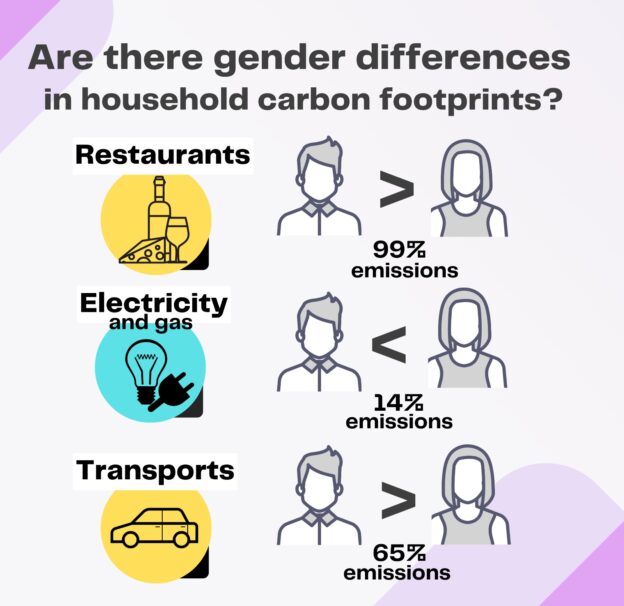
Pilar Osorio, María Ángeles Tobarra, and Manuel Tomás have recently published in the Journal of Ecological Economics the paper entitled «Are there gender differences in household carbon footprints? Evidence from Spain».
In this paper, the carbon footprints of Spanish households are calculated using an environmentally extended multiregional input-output model combined with microdata from the Spanish Household Budget Survey.
Results show that households with a majority of men have a higher carbon footprint and carbon intensity.
Female households spend more (and generate more emissions) on housing supplies and food products, while male households show that pattern for restaurants and transport .
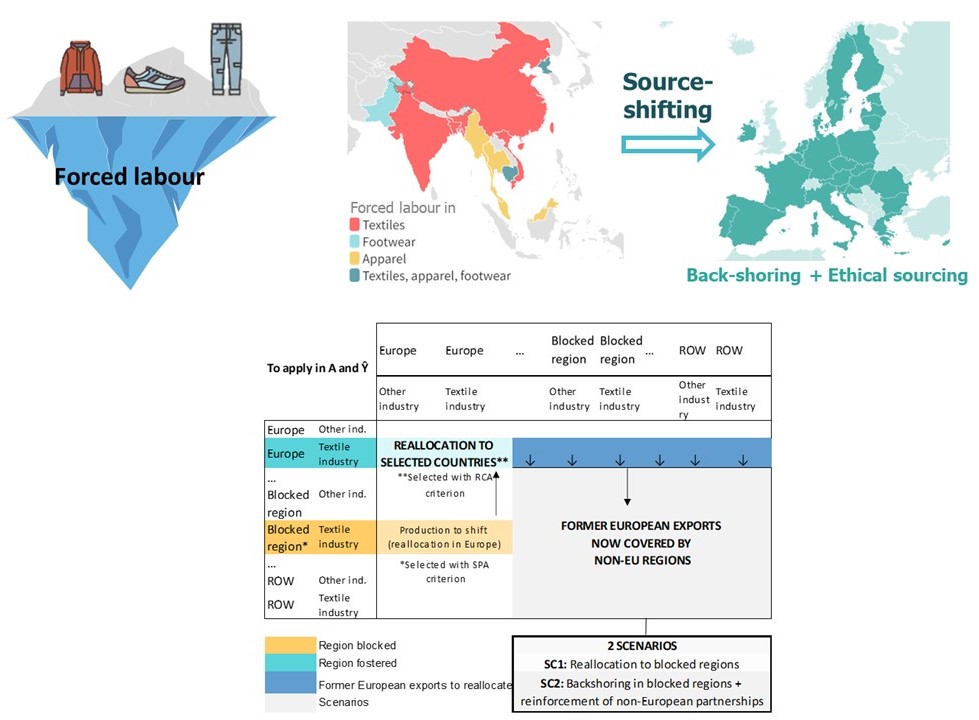
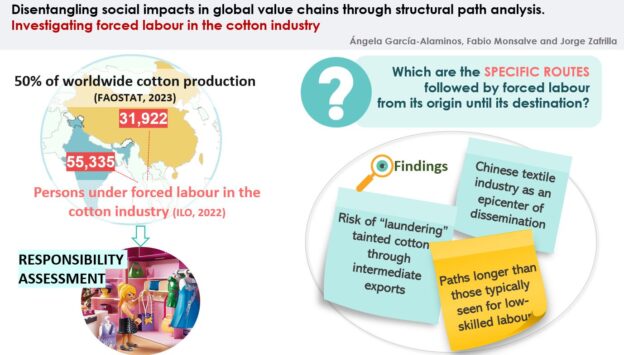
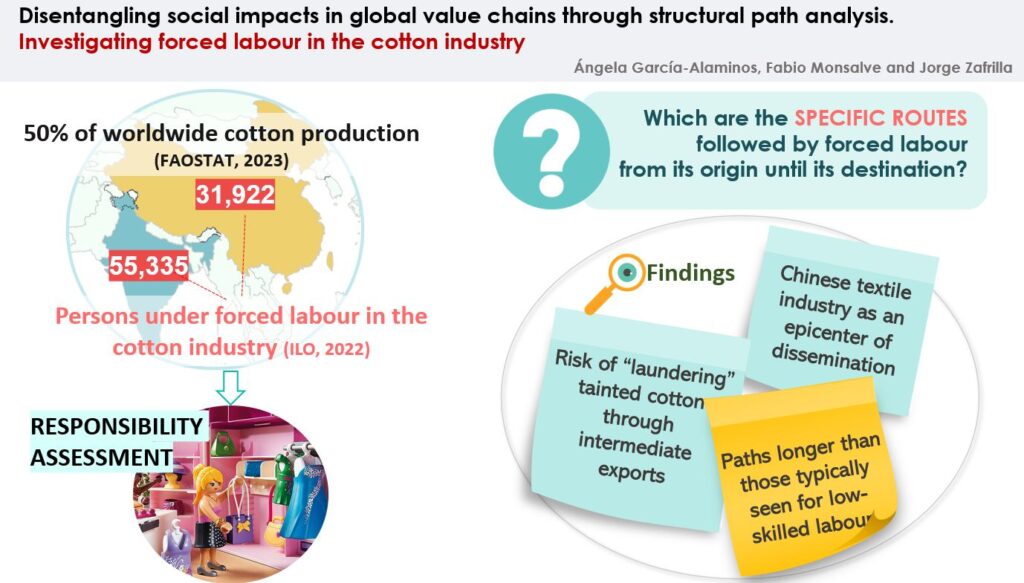
The GEAR members Ángela García-Alaminos, Fabio Monsalve and Jorge Zafrilla have recently published in the Journal of Industrial Ecology the paper entitled “Disentangling social impacts in global value chains through structural path analysis”.
This analysis proposes an analytical method to trace the precise pathways through which impacts from a specific origin are disseminated worldwide and embodied in high-income nations’ consumption.
Our work relies on a multi-regional input–output model extended with the structural path analysis (SPA) methodology. The SPA method is explored both in gross and net terms as complementary perspectives to disentangle the complexity of global value chains, which is the main contribution of our approach.
We take as a case study the forced labor in the two major worldwide cotton producers (India an China). Based on ILO data, we estimate that there are at least 32,000 and 55,300 persons being coerced into forced picking in China and India, respectively.
Our results show that more than 13% of the estimated forced workers are attributed to the European Union and the United States consumption, respectively, with apparel, footwear, and textiles as key goods embodying these workers.
Key findings show a high number of intrasectoral transformations inside the Chinese and Indian textile industries, which hinders the traceability of forced labour at the first stages of the fashion value chains. We also show that forced labor in the Chinese cotton industry is even more distant to the final consumer than usual unskilled labor, which is an additional obstacle to its eradication.
The GEAR members Carmen Córcoles, Pilar Osorio, Luis Antonio López and Jorge Zafrilla have recently published in Energy Policy the paper entitled: «The carbon footprint of the empty Castilla-La Mancha».
This paper is part of our regional project that has just started! We analyzed the carbon footprint of Castilla-La Mancha households and their mitigation potential by using the environmentally extended multiregional input-output model and HBS microdata.
What did we find? Small municipalities generate more direct emissions and have a higher carbon intensity because the lack of transport services leads them to use more private vehicles. The larger the size of the municipality, the lower the carbon intensity.
We found that the mitigation potential of the CLM household carbon footprint accounts for 20.1% Adopting a more sustainable consumption pattern could lower emissions by 2.43 tCO2!
The 43% of households in Castilla-La Mancha, which are living in municipalities of less than 10,000 inhabitants, have more difficulties modifying their housing and transport behavior than the largest municipalities. Mitigation policies must especially support small municipalities and their inhabitants. Infrastructure and social services must be developed to facilitate a change in their consumption patterns!
Towards a World Integrated and Socio-economically Balanced European Economic Development Scenario (TWIN SEEDS) is a research project funded within the Horizon Europe program led by Politecnico di Milano (Grant agreement ID: 101056793)
The project studies the recent evolution of Global Value Chains (GVC), with the aim of understanding the role played by technological transformations and geopolitical and policy shifts in shaping these changes. Thanks to the joint effort of eleven universities and research institutions from eight EU countries, TWIN SEEDS is expected to enrich the European debates and public policies aiming at economic prosperity, social cohesion and environmental quality in the light of the still unknown effects of GVC reconfiguration.
The GEAR member, Ángela García Alaminos has completed her PhD!! Congratulations!!
Under the supervision of Jorge Zafrilla and Fabio Monsalve, the thesis entitled «Trabajo indigno en las cadenas globales de valor: un análisis de responsabilidades», presents four chapters, three peer-reviewed publications, and one under-review publication. You can access the already-published papers here:
García-Alaminos, Á., et al. (2020). «Reassembling social defragmented responsibilities: the indecent labour footprint of US multinationals overseas.» Economic Systems Research: 1-19. LINK
García-Alaminos, Á., Monsalve, F., Zafrilla, J., & Cadarso, M.-A. (2020). Unmasking social distant damage of developed regions’ lifestyle: A decoupling analysis of the indecent labour footprint. PLoS ONE, 15(4) LINK
Monsalve, F., Zafrilla, J.E., Cadarso, M.-Á., and García-Alaminos, Á. 2018. Is the emperor wearing new clothes? A social assessment of the European Union 2007–2013 financial framework. Economic Systems Research: 1-20 in press. LINK
In Ángela’s dissertation thesis defense, we were able to enjoy a masterful presentation in which she demonstrated a very high level of knowledge about the abject phenomenon of indecent work along the global production chains.
The thesis tribunal was formed by the renowned doctors Rocío Román, from the University of Seville, Iñaki Arto, from BC3 of the Basque Country, and André Carrascal, from the University of Oviedo.
Undoubtedly, a day to remember for the GEAR group.
Congratulations, Ángela, for your outstanding thesis, incredible work capacity, and generosity in sharing it.