Archivo de la categoría: Publications

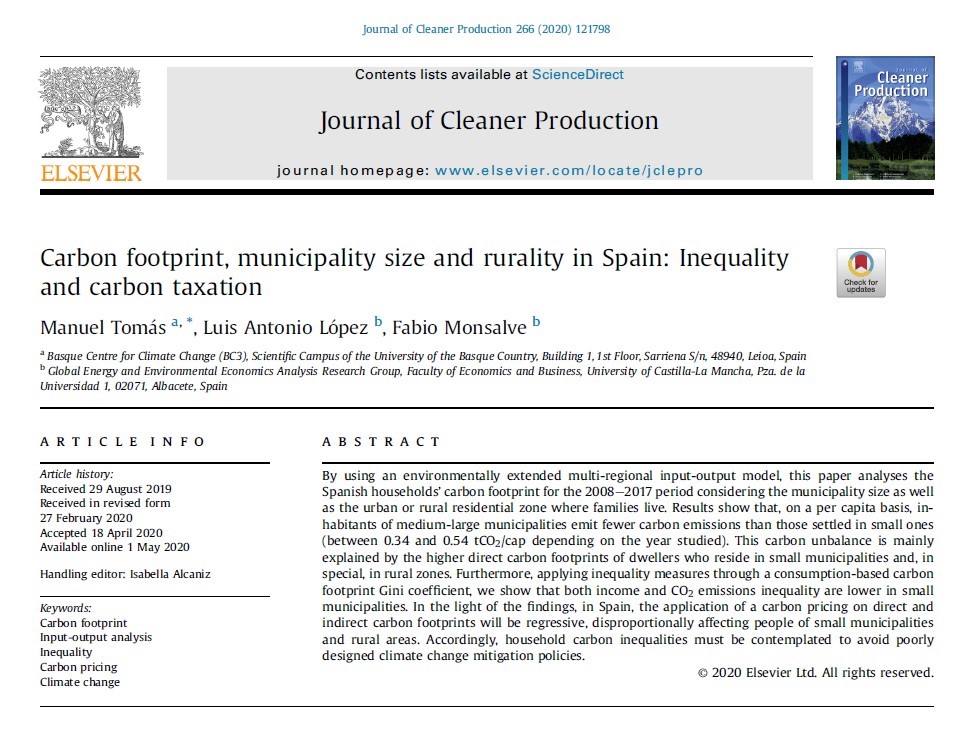
NEW PUBLICATION IN JOURNAL OF CLEANER PRODUCTION

The GEAR members Manuel Tomás, Luis A. López and Fabio Monsalve, have recently published the article entitled «Carbon footprint, municipality size and rurality in Spain: Inequality and carbon taxation» in Journal of Cleaner Production.

In this paper, the authors assess the Spanish households’ carbon footprint for the 2008-2017 period considering the municipality size as well as the urban or rural residential zone. In light of the results, they test whether the carbon footprint inequality among households could lead to asymmetric regressive impacts based on where families live.

We hope you enjoy it!

Link: https://www.sciencedirect.com/science/article/pii/S095965262031845X 
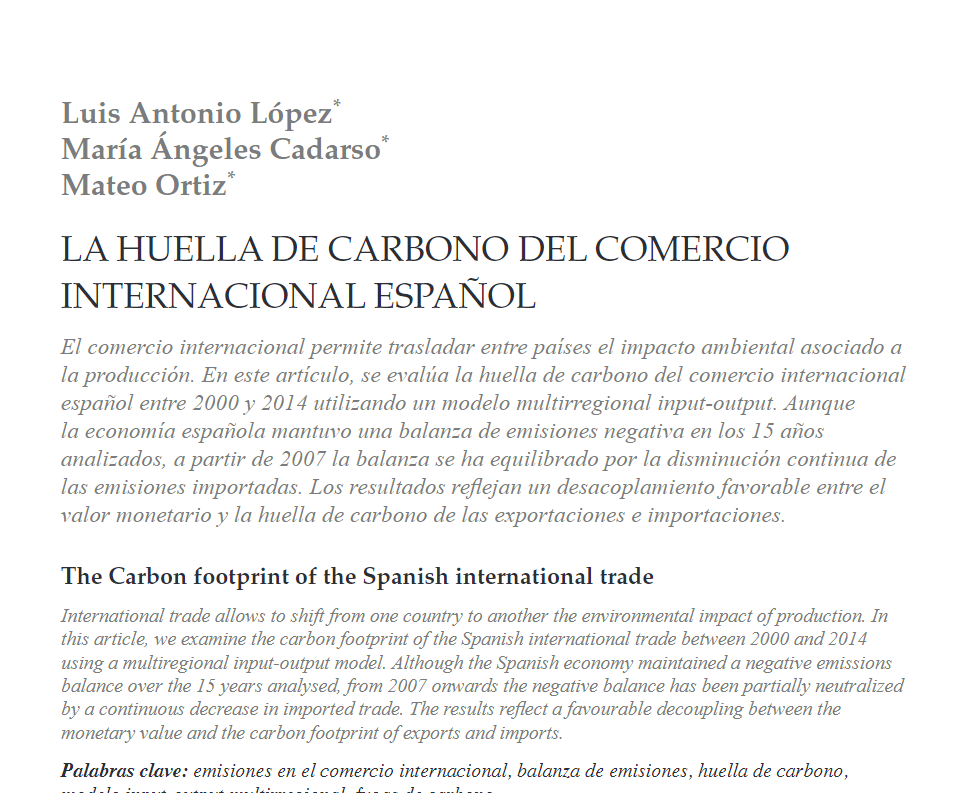
NEW PUBLICATION IN THE SPANISH JOURNAL ICE, JOURNAL OF ECONOMICS

GEAR group members Luis Antonio López, Maria Ángeles Cadarso and Mateo Ortiz carried out a study on the evolution of CO2 emissions embodied in Spain’s imports and exports during 2005-2014. In the paper entitled ‘The carbon footprint of the Spanish international trade’ the authors quantify and analyse the CO2 emissions associated with Spain’s traded products and provide valuable insights on the role played by international trade in the Spanish and European pursuit for low-carbon production and consumption.

Please, CLICK HERE to read the full paper (only available in Spanish). We hope you like it.

ICE, Journal of Economics is an academic journal published by the Ministry of Industry, Trade and Tourism of Spain whose scope is to contribute to the debate of economic policy.

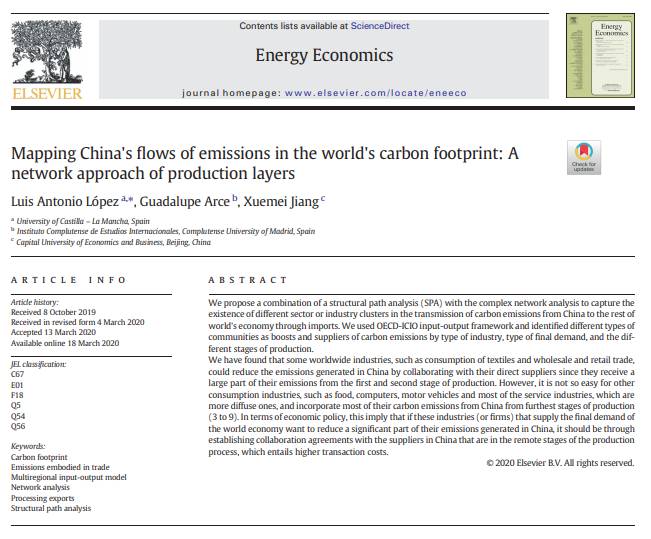
NEW PUBLICATION IN ENERGY ECONOMICS

The GEAR members Luis Antonio López (UCLM) and Guadalupe Arce (Complutense University), in collaboration with Xuemei Jiang (Capital University of Economics and Business of Beijing), have recently published «Mapping China’s flows of emissions in the world’s carbon footprint: A network approach of production layers» in Energy Economics. 

In this paper the authors propose a combination of the environmental extended Multiregional Input-Output Model (EE-MRIO), applying a Structural Path Analysis, with the complex network analysis to adequately identify different types of communities or clusters of sector as boost and suppliers of carbon emissions by type of sector (processing exports, non-processing exports and China normal production), type of final demand (consumption and investment) and the different stages of production. 

This approach is an important novelty in the input-output literature because, in our opinion, the research is useful to assess the scope of possibilities that companies of different sectors have regarding reducing their carbon footprint and the limit implied for the transmission of technology between companies in the same sector or companies that relocate their production to China.

We hope you enjoy it!

LINK: https://www.sciencedirect.com/science/article/pii/S0140988320300785

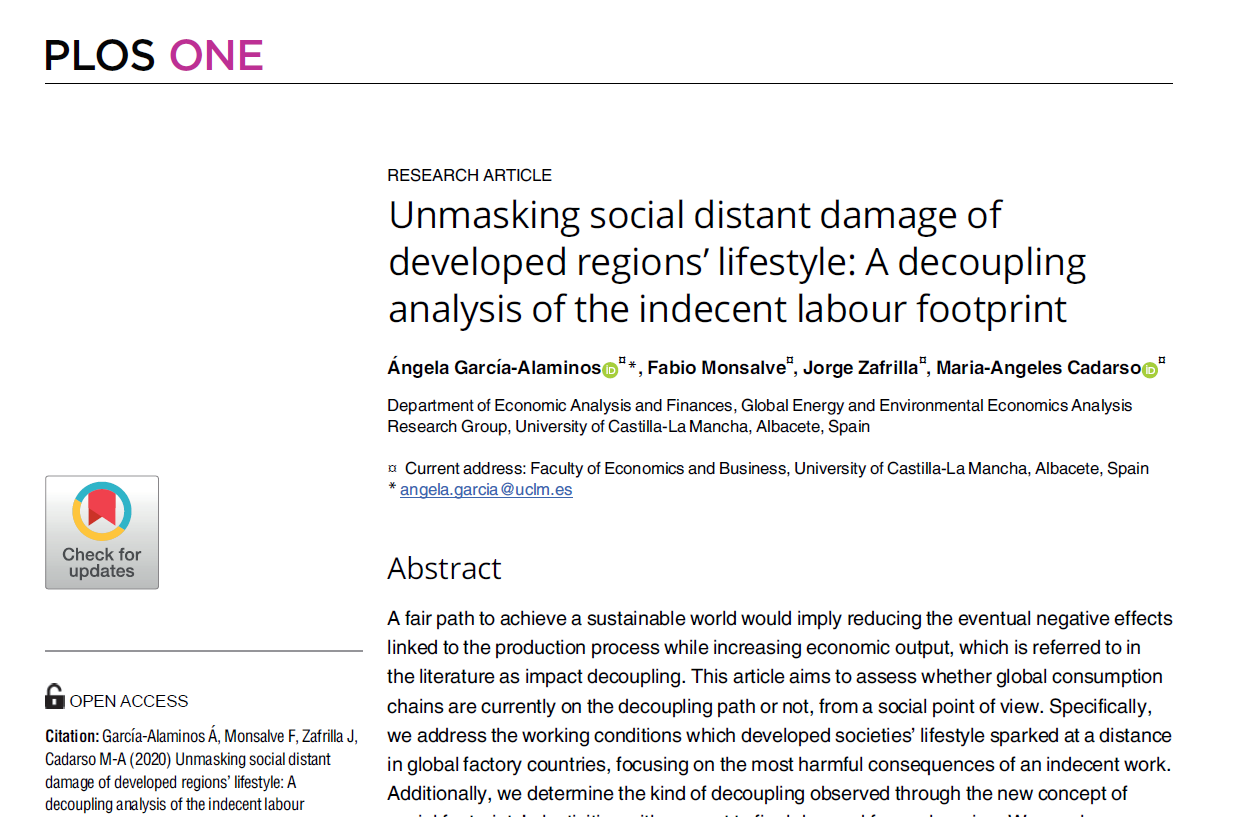
NEW PUBLICATION IN PLOS ONE

Some members of the GEAR Group have recently published a new research article in PLOS ONE.

The paper, entitled “Unmasking social distant damage of developed regions’ lifestyle: A decoupling analysis of the indecent labour footprint” presents news insights about the indecent labour footprints. Using the indecent labour database developed by Ángela García-Alaminos to assess the indecent labour footprint, we propose a decoupling analysis to evaluate whether global consumption chains are currently on the decoupling path or not, from a social point of view.

The paper has been written by Ángela García-Alaminos, Fabio Monsalve, Jorge Zafrilla and María Ángeles Cadarso.

And if you can read Spanish, please discover our disclosure piece published in The Conversation about the article:  https://theconversation.com/trabajo-precario-el-dano-que-no-vemos-cuando-consumimos-131275

 We hope you enjoy this paper!

ACCESS TO FULL PAPER: LINK

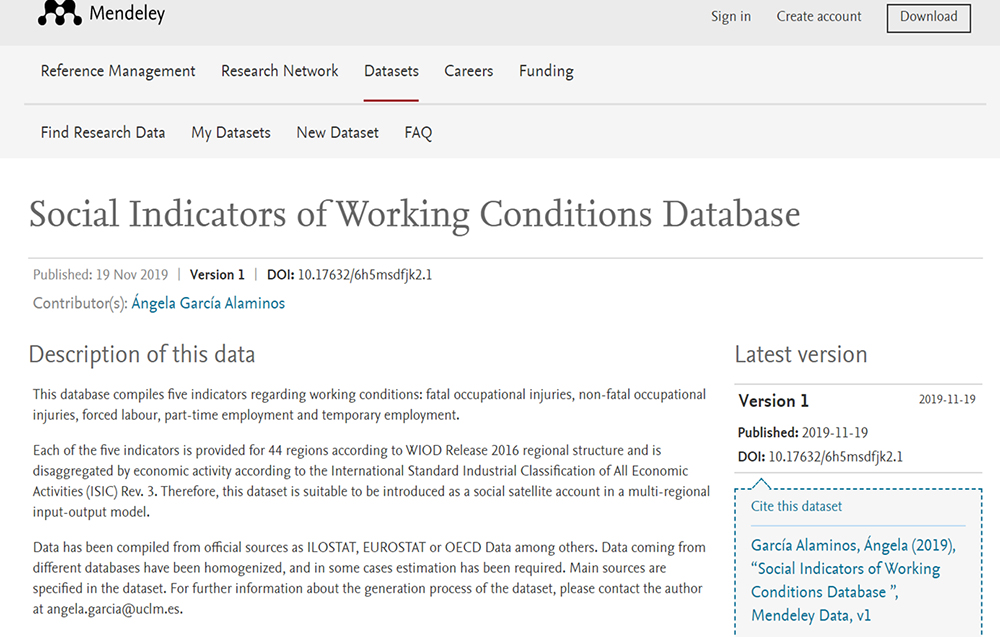
SOCIAL IMPACTS DATABASE RELEASED BY GEAR

GEAR member Ángela García Alaminos has recently published in an open repository a “Social Indicators of Working Conditions Database”. This database compiles five indicators regarding working conditions: fatal occupational injuries, non-fatal occupational injuries, forced labor, part-time employment, and temporary employment. Each of the five indicators is provided for 44 regions and disaggregated by economic activity, which makes this dataset a social satellite account suitable with multi-regional input-output models.

Main sources are specified in the dataset. For further information about the generation process of the dataset, please contact the author at angela.garcia@uclm.es.

The database can be found in Mendeley Data (http://dx.doi.org/10.17632/6h5msdfjk2.1)  under CC BY 4.0 Licence. To use the data, please cite García-Alaminos, Ángela (2019), “Social Indicators of Working Conditions Database ”, Mendeley Data, v1.