Archivo de la categoría: Publications

NEW PUBLICATION IN STRUCTURAL CHANGE AND ECONOMIC DYNAMICS

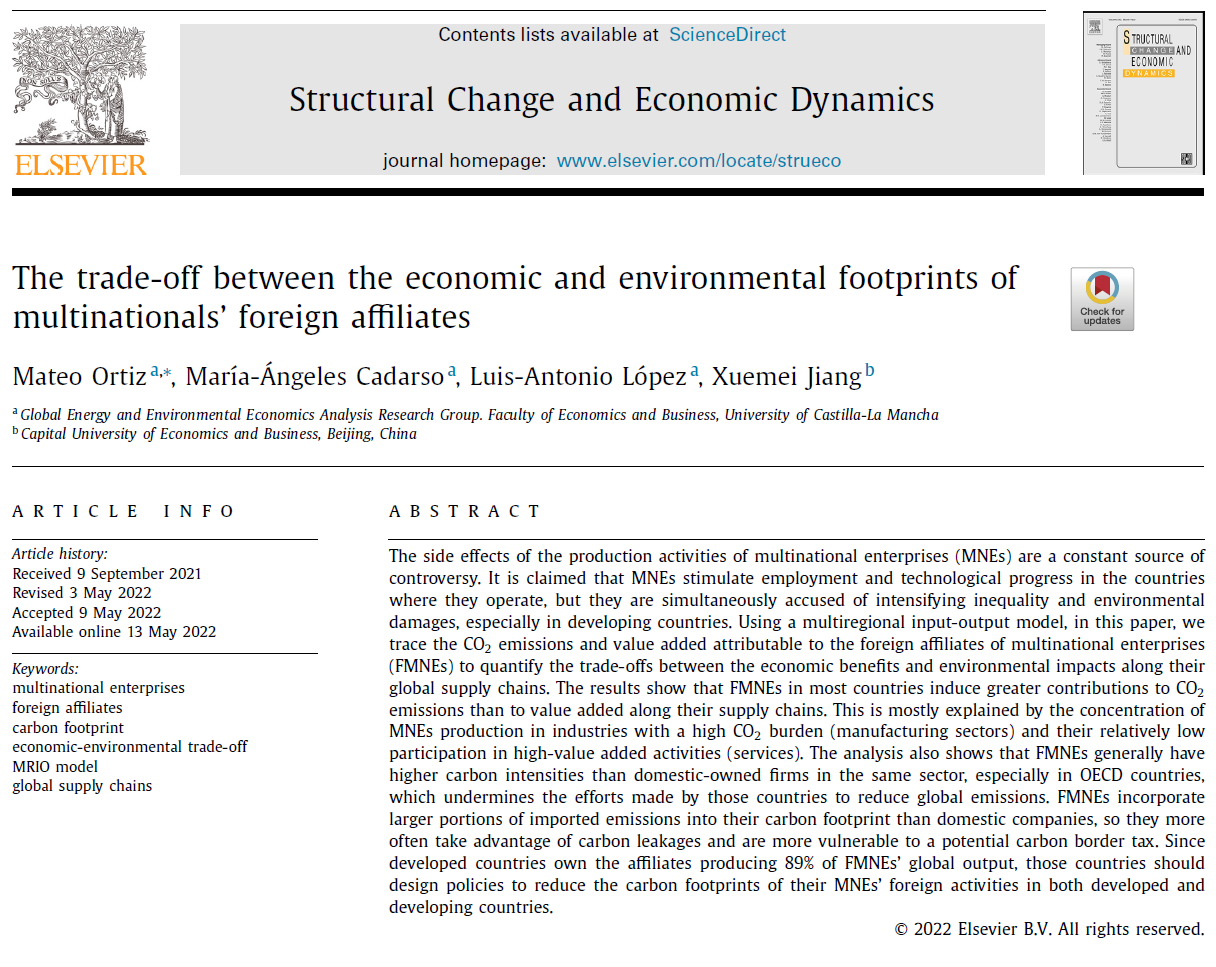
GEAR members Mateo Ortiz, Maria Ángeles Cadarso and Luis Antonio López achieve a new publication on the global supply chains of multinational enterprises, this time in collaboration with our colleague Xuemei Jiang of Capital University of Economics and Business (Beijing, China).

In the paper entitled “The trade-off between the economic and environmental footprints of multinationals’ foreign affiliates”, the authors trace the CO2 emissions and value added generated along the global supply chains of multinationals and quantify the trade-offs between their economic benefits and environmental impacts. They found that value added and ownership are concentrated in developed countries, while CO2 emissions are mostly released in developing countries.

The article also provides comparisons between the economic-environmental performance of multinationals and domestic-owned companies. In this respect, it finds that foreign affiliates in OECD countries show higher CO2 intensities and carbon leakages than the domestic firms in the same countries.

We strongly encourage you to read this great article on a very interesting topic. We hope you like it!

Link: https://doi.org/10.1016/j.strueco.2022.05.005

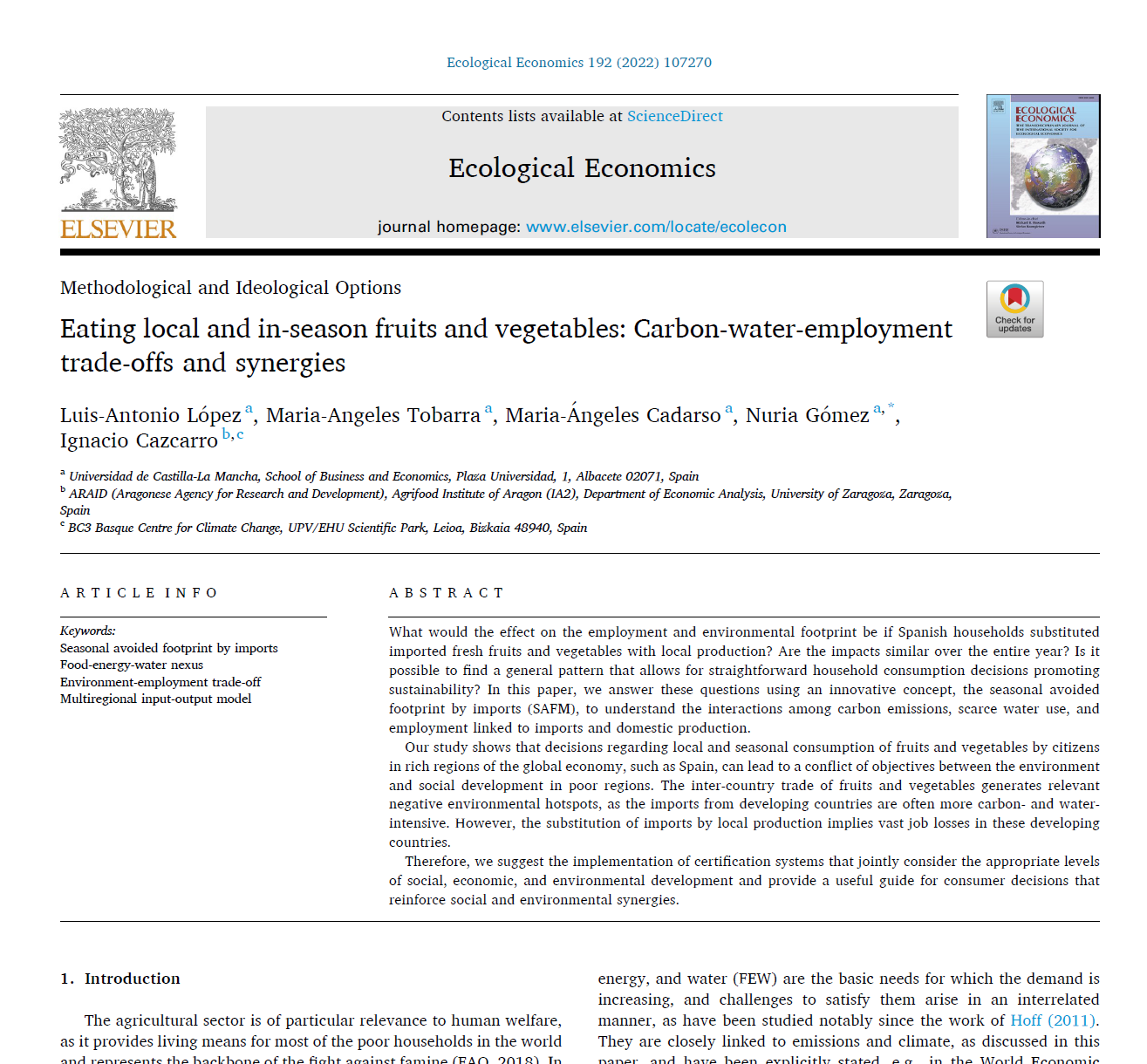
NEW PUBLICATION IN ECOLOGICAL ECONOMICS

The GEAR members Luis Antonio López, María Ángeles Tobarra, María Ángeles Cadarso y Nuria Gómez, in collaboration with Ignacio Cazcarro, Enrique Gilles, researcher at BC3 and University of Zaragoza, have recently published in Ecological Economics the paper entitled: « Eating local and in-season fruits and vegetables: Carbon-water-employment trade-offs and synergies».

This paper explores the interactions among carbon emissions, scarce water use, and employment linked to imports and domestic production. The decision to consume domestic or imported products has consequences at different levels, this work allows us to compare the impact on greenhouse gases, water and the creation of new jobs by applying an innovative decisions analysis tool, the seasonal avoided footprint by imports (SAFM). Obtained results point to the need to design certification systems that jointly consider appropriate social, economic, and environmental issues.

Link: https://www.sciencedirect.com/science/article/pii/S0921800921003293

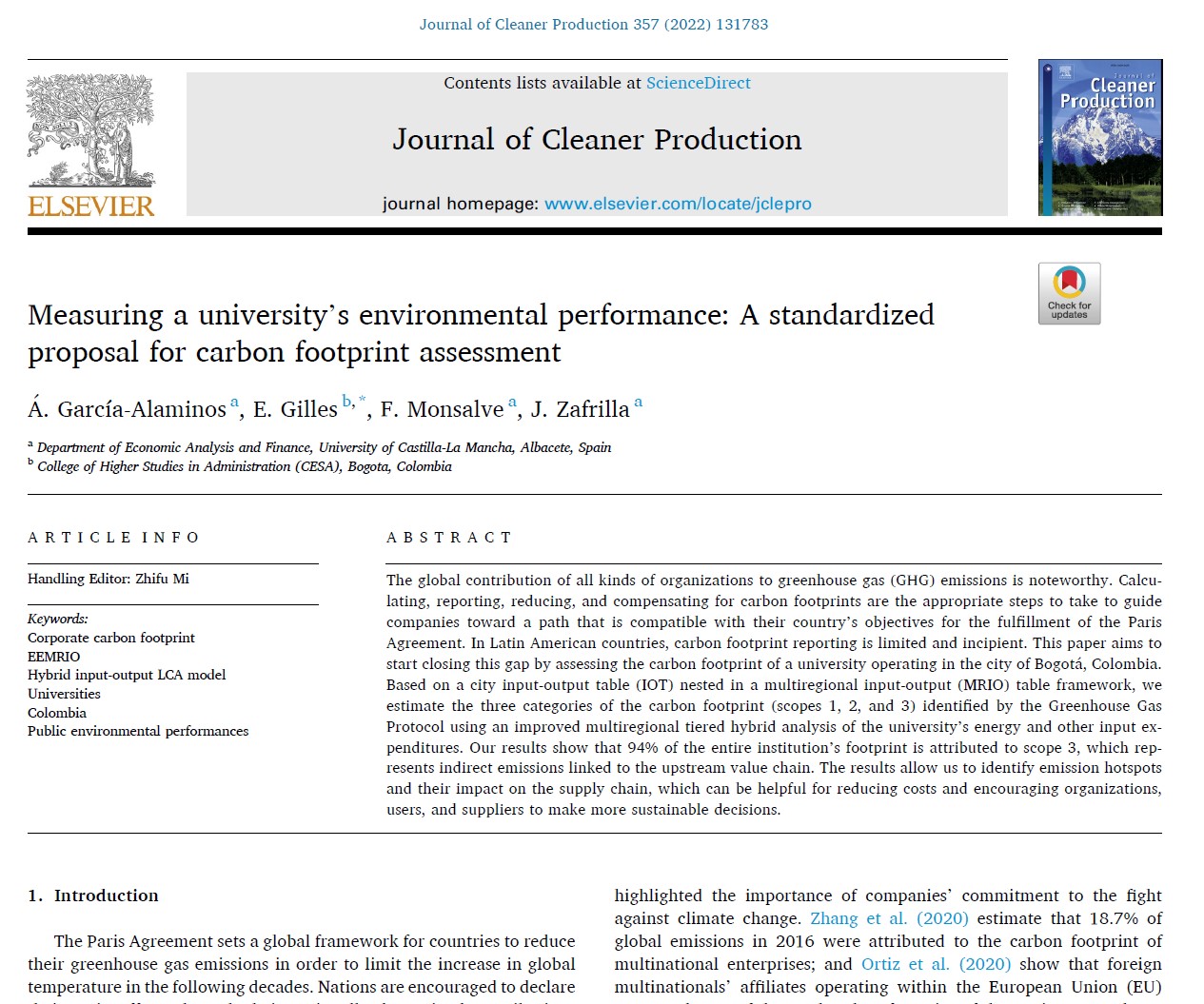
NEW PUBLICATION IN THE JCP

The GEAR members Ángela García, Jorge Zafrilla, and Fabio Monsalve, in collaboration with Enrique Gilles, researcher at @CESA_edu, have recently published in the Journal of Cleaner Production the paper entitled: «Measuring a university’s environmental performance: A standardized proposal for carbon footprint assessment».

This paper explores the role of organizations fighting climate change and offers a standardized and refined model to assess the direct and indirect carbon footprint embodied in the organization’s activity. In the analyzed case, a Colombian University, results show how more than 94% of total emissions are indirect. Computing indirect emissions along the global value chains are crucial for an effective fight against global warming.

Please, enjoy this 50 days of free access to the paper: https://www.sciencedirect.com/science/article/pii/S0959652622013956?dgcid=coauthor

NEW PUBLICATION IN SCIENCE OF THE TOTAL ENVIRONMENT

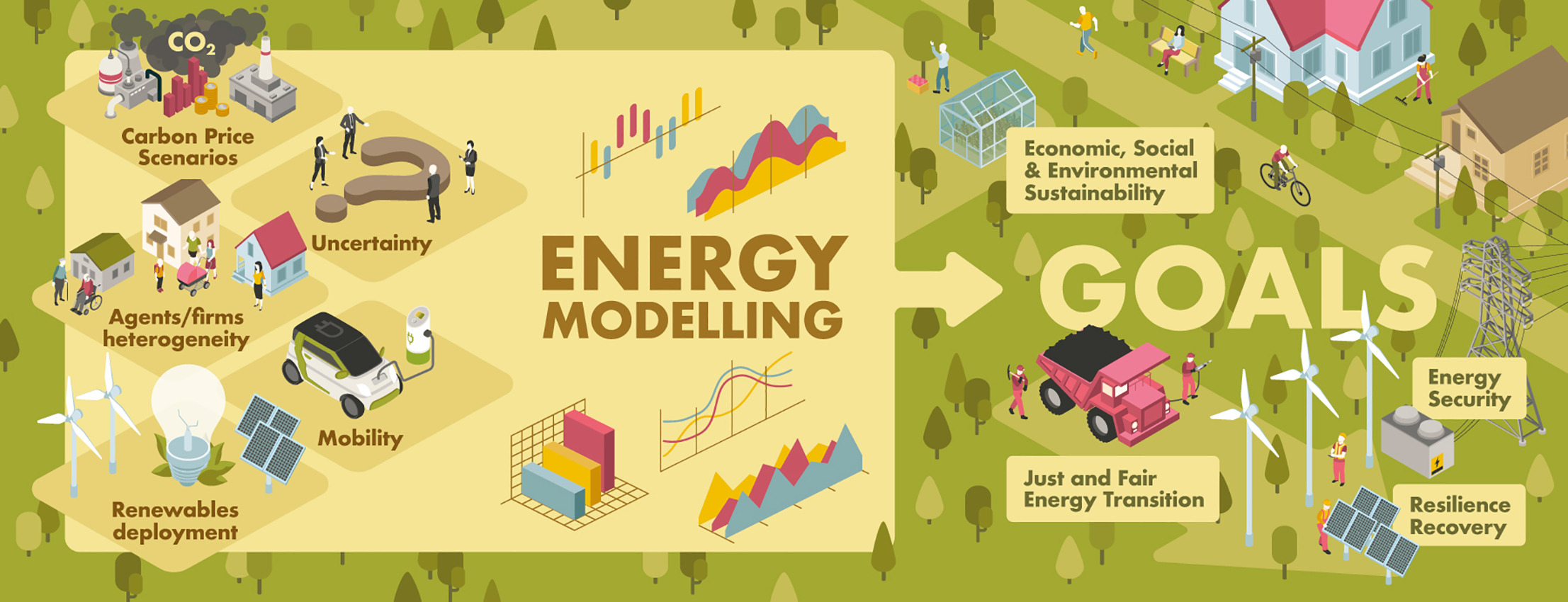
The Science Network RED MENTES has recently published a joint contribution entitled “Energy-socio-economic-environmental modelling for the EU energy and post-COVID-19 transitions” in the journal Science of the Total Environment.

The paper argues how recovery plans are an opportunity to deepen the way towards a low-carbon economy, improving at the same time employment, health, and equity and the role of modelling tools. It is based on contributions from many network members and tries to justify how multidisciplinary modeling is key to the successful development of the energy transition. Policies must be focused on both short-term and long-term goals, and the assessment of the social impacts of the energy transition must be highlighted. The scientific community has to assess disparate, non-equilibrium, and non-ordinary scenarios, such as sectors and countries lockdowns, drastic changes in consumption patterns, significant investments in renewable energies, and disruptive technologies, and incorporate uncertainty analysis

This paper has been written by Ignacio Cazcarro, Diego García-Gusano,  Diego Iribarren, Pedro Linares José Carlos Romero, Pablo Arocena, Iñaki Arto, Santacruz Banacloche, Yolanda Lechón, Luis Javier Miguel, Jorge Zafrilla, Luis-Antonio López, Raquel Langarita y María-Ángeles Cadarso, from ARAID and University of Zaragoza, Tecnalia, IMDEA, Comillas Pontificial  University, Public University of Navarra, Basque Centre for Climate Change (BC3), CIEMAT, University of Valladolid and University of Castilla-La Mancha.

Read us at: https://www.sciencedirect.com/science/article/pii/S0048969721054061

NEW PUBLICATION in Renewable and Sustainable Energy Reviews

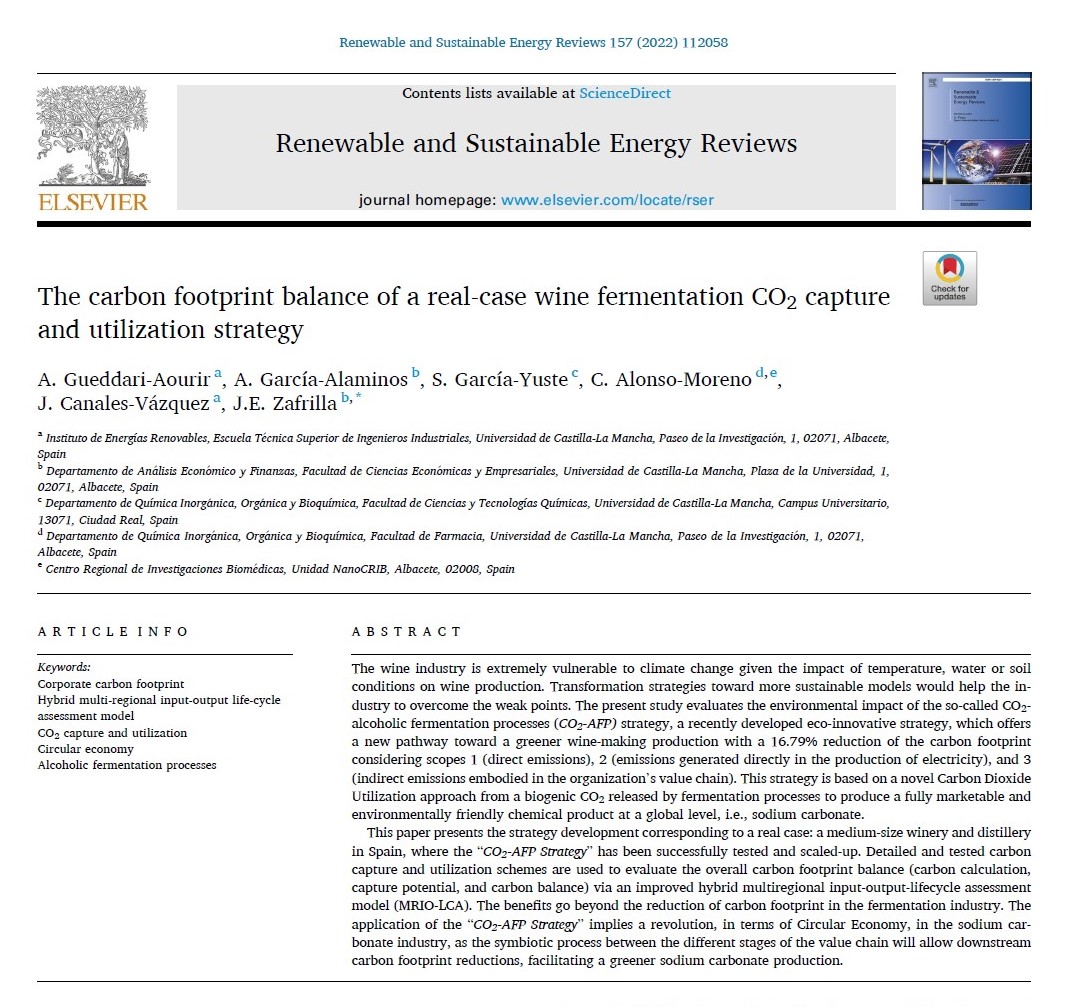
UCLM researchers Abdessamad Gueddari-Aourir, Santiago García-Yuste, Carlos Alonso-Moreno, and Jesús Canales-Vázquez together with the GEAR Group members Ángela García-Alaminos and Jorge Zafrilla have recently published a new research article in Renewable and Sustainable Energy Reviews.

The paper, entitled “The carbon footprint balance of a real-case wine fermentation CO2 capture and utilization strategy”, evaluates the environmental impact of the so-called CO2-alcoholic fermentation processes (CO2-AFP) strategy, a recently developed eco-innovative strategy. This proposal offers a new pathway toward a greener wine-making production with a 16.79% reduction of the carbon footprint considering scopes 1 (direct emissions), 2 (emissions generated directly in the production of electricity), and 3 (indirect emissions embodied in the organization’s value chain). The paper presents the strategy development corresponding to a real case: a medium-size winery and distillery in Spain, where the “CO2-AFP Strategy” has been successfully tested and scaled up. Detailed and tested carbon capture and utilization schemes are used to evaluate the overall carbon footprint balance (carbon calculation, capture potential, and carbon balance) via an improved hybrid multiregional input-output-lifecycle assessment model (MRIO-LCA). The benefits go beyond the reduction of carbon footprint in the fermentation industry. The application of the “CO2-AFP Strategy” implies a revolution, in terms of Circular Economy, in the sodium carbonate industry, as the symbiotic process between the different stages of the value chain will allow downstream carbon footprint reductions, facilitating a greener sodium carbonate production.

We hope you enjoy it!    LINK