Archivo de la categoría: Publications

NEW PUBLICATION IN THE JOURNAL OF INDUSTRIAL ECOLOGY

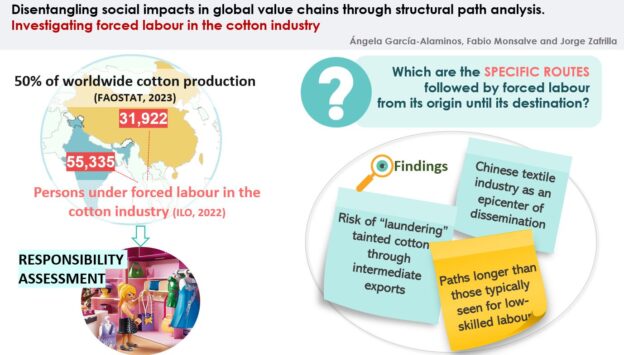
The GEAR members Ángela García-Alaminos, Fabio Monsalve and Jorge Zafrilla have recently published in the Journal of Industrial Ecology the paper entitled “Disentangling social impacts in global value chains through structural path analysis”.

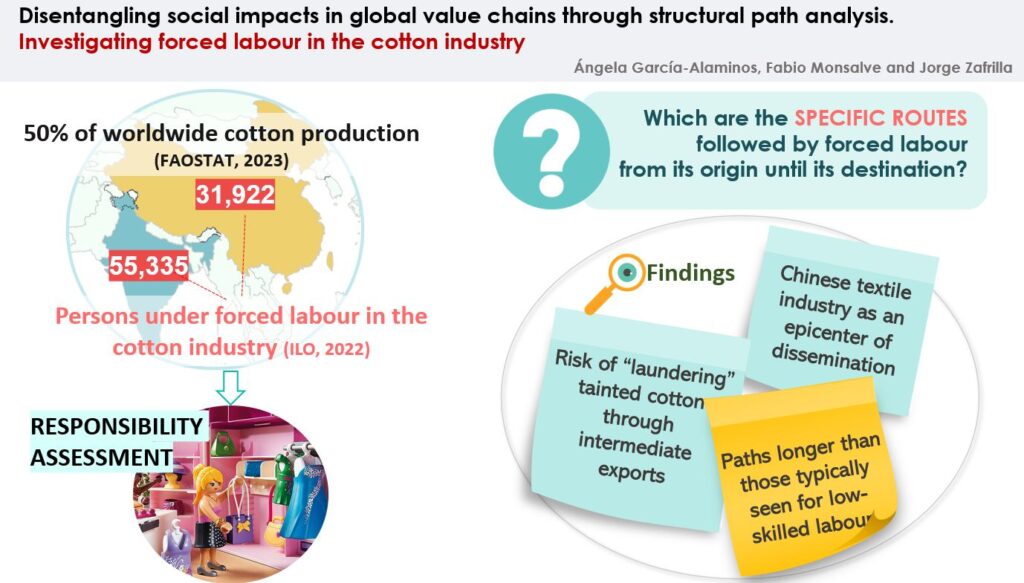
This analysis proposes an analytical method to trace the precise pathways through which impacts from a specific origin are disseminated worldwide and embodied in high-income nations’ consumption.

Our work relies on a multi-regional input–output model extended with the structural path analysis (SPA) methodology. The SPA method is explored both in gross and net terms as complementary perspectives to disentangle the complexity of global value chains, which is the main contribution of our approach.

We take as a case study the forced labor in the two major worldwide cotton producers (India an China). Based on ILO data, we estimate that there are at least 32,000 and 55,300 persons being coerced into forced picking in China and India, respectively.

Our results show that more than 13% of the estimated forced workers are attributed to the European Union and the United States consumption, respectively, with apparel, footwear, and textiles as key goods embodying these workers.

Key findings show a high number of intrasectoral transformations inside the Chinese and Indian textile industries, which hinders the traceability of forced labour at the first stages of the fashion value chains. We also show that forced labor in the Chinese cotton industry is even more distant to the final consumer than usual unskilled labor, which is an additional obstacle to its eradication.

You can find the full-text here: 
https://onlinelibrary.wiley.com/share/author/WERSJEV8TERZFN8CCPFC?target=10.1111/jiec.13359.

NEW PUBLICATION IN ENERGY ECONOMICS

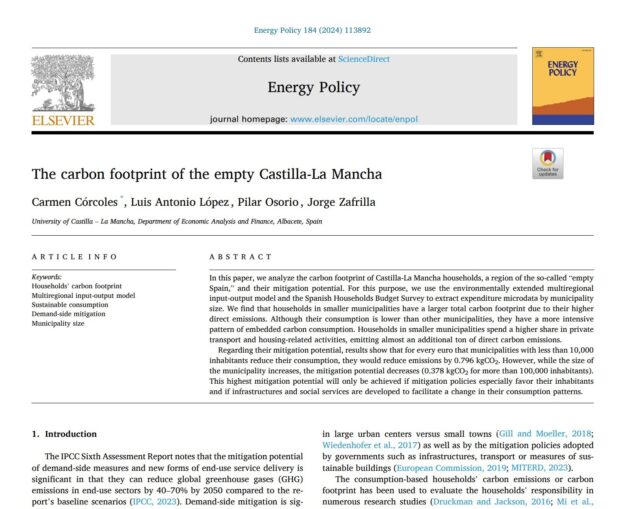
The GEAR members Carmen Córcoles, Pilar Osorio, Luis Antonio López and Jorge Zafrilla have recently published in Energy Policy the paper entitled: «The carbon footprint of the empty Castilla-La Mancha».

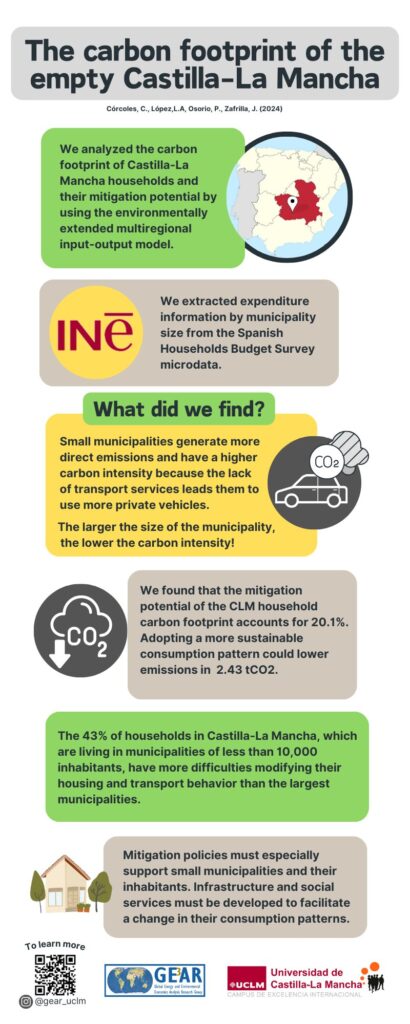
This paper is part of our regional project that has just started! We analyzed the carbon footprint of Castilla-La Mancha households and their mitigation potential by using the environmentally extended multiregional input-output model and HBS microdata.

What did we find? Small municipalities generate more direct emissions and have a higher carbon intensity because the lack of transport services leads them to use more private vehicles. The larger the size of the municipality, the lower the carbon intensity.

We found that the mitigation potential of the CLM household carbon footprint accounts for 20.1% Adopting a more sustainable consumption pattern could lower emissions by 2.43 tCO2!

The 43% of households in Castilla-La Mancha, which are living in municipalities of less than 10,000 inhabitants, have more difficulties modifying their housing and transport behavior than the largest municipalities. Mitigation policies must especially support small municipalities and their inhabitants. Infrastructure and social services must be developed to facilitate a change in their consumption patterns!

50 days open access: https://authors.elsevier.com/a/1i4Bw14YGgpcrh…

NEW PUBLICATION IN STRUCTURAL CHANGE AND ECONOMIC DYNAMICS

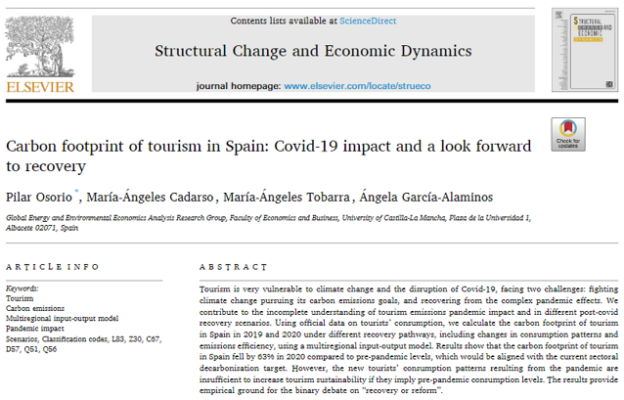
The GEAR members Pilar Osorio, María Ángeles Cadarso, María Ángeles Tobarra and Ángela García-Alaminos have recently published in Structural Change and Economic Dynamics the paper entitled: «Carbon footprint of tourism in Spain: Covid-19 impact and a look forward to recovery».

This paper quantifies the impact of the pandemic on Spanish tourism carbon footprint by using an environmentally extended multiregional input-output model. It also provides several scenarios to evaluate possible trends of tourism recovery and their impact on emissions. The results show that more ambition is needed: major changes in consumption patterns and efficiency are required to get on track towards the Net Zero targets.

We invite you to read the article and hope you find it interesting.

Link: https://www.sciencedirect.com/science/article/pii/S0954349X23000358

NEW PUBLICATION IN GLOBAL ENVIRONMENTAL CHANGE

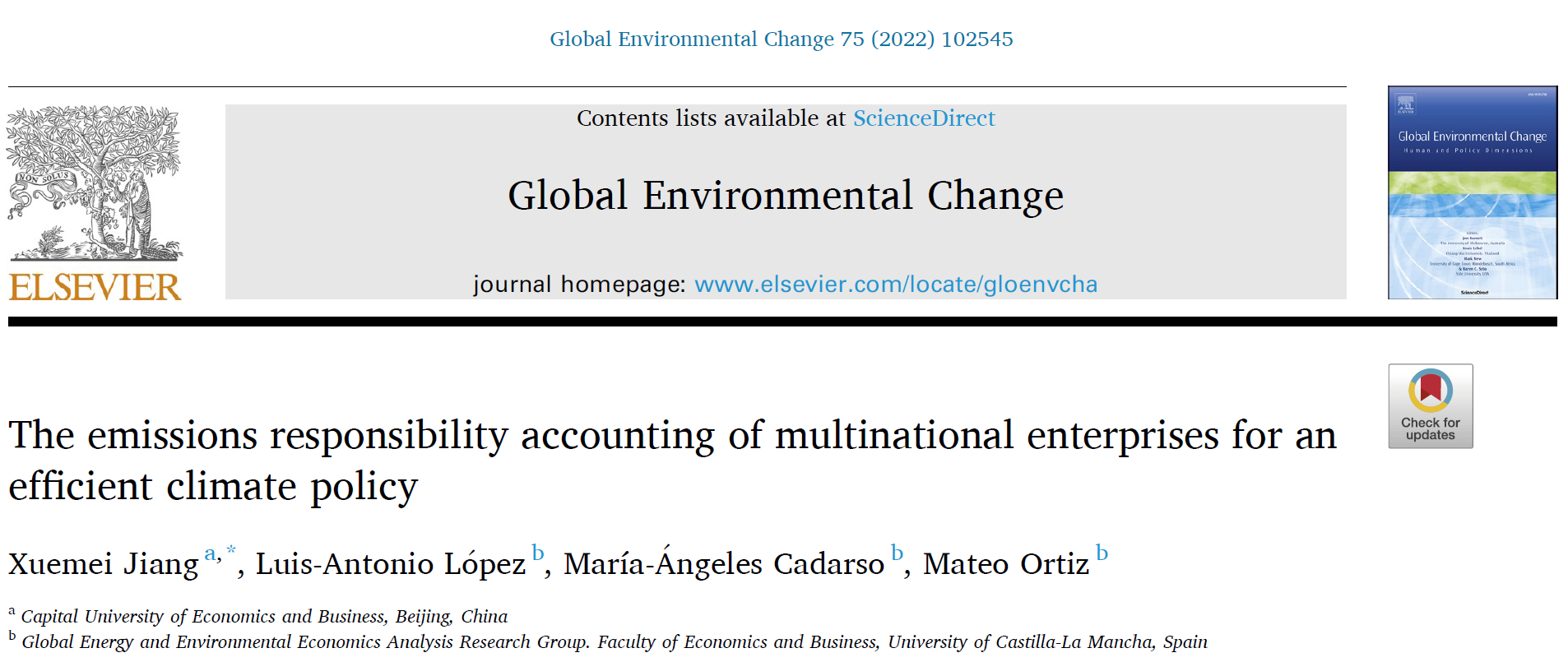
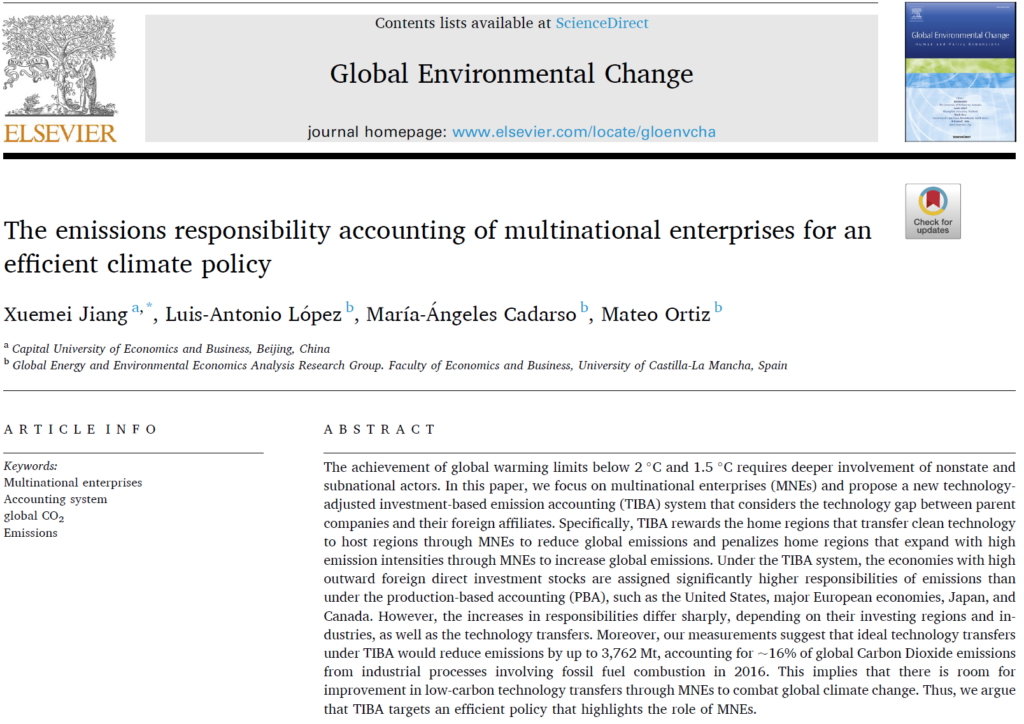
The journal Global Environmental Change published a new research by GEAR member. This article is the result of a new collaboration between Luis Antonio López, María Ángeles Cadarso and Mateo Ortiz with Prof. Xuemei Jiang (Capital University of Economics and Business, Beijing). In the paper entitled “The emissions responsibility accounting of multinational enterprises for an efficient climate policy”, the authors propose a novel method to allocate CO2 emissions among countries integrating the emissions transfers through multinationals and foreign investment. This method, called technology-adjusted investment-based emission accounting (TIBA), rewards the home regions of multinationals that transfer clean technology to other regions through their affiliates.

The main finding of the work indicates that the application of the TIBA method on a global scale has the potential to reduce global CO2 emissions up to 16%.

We invite you to read the article and hope you find it interesting.

Link: https://doi.org/10.1016/j.gloenvcha.2022.102545

NEW PUBLICATION IN STRUCTURAL CHANGE AND ECONOMIC DYNAMICS

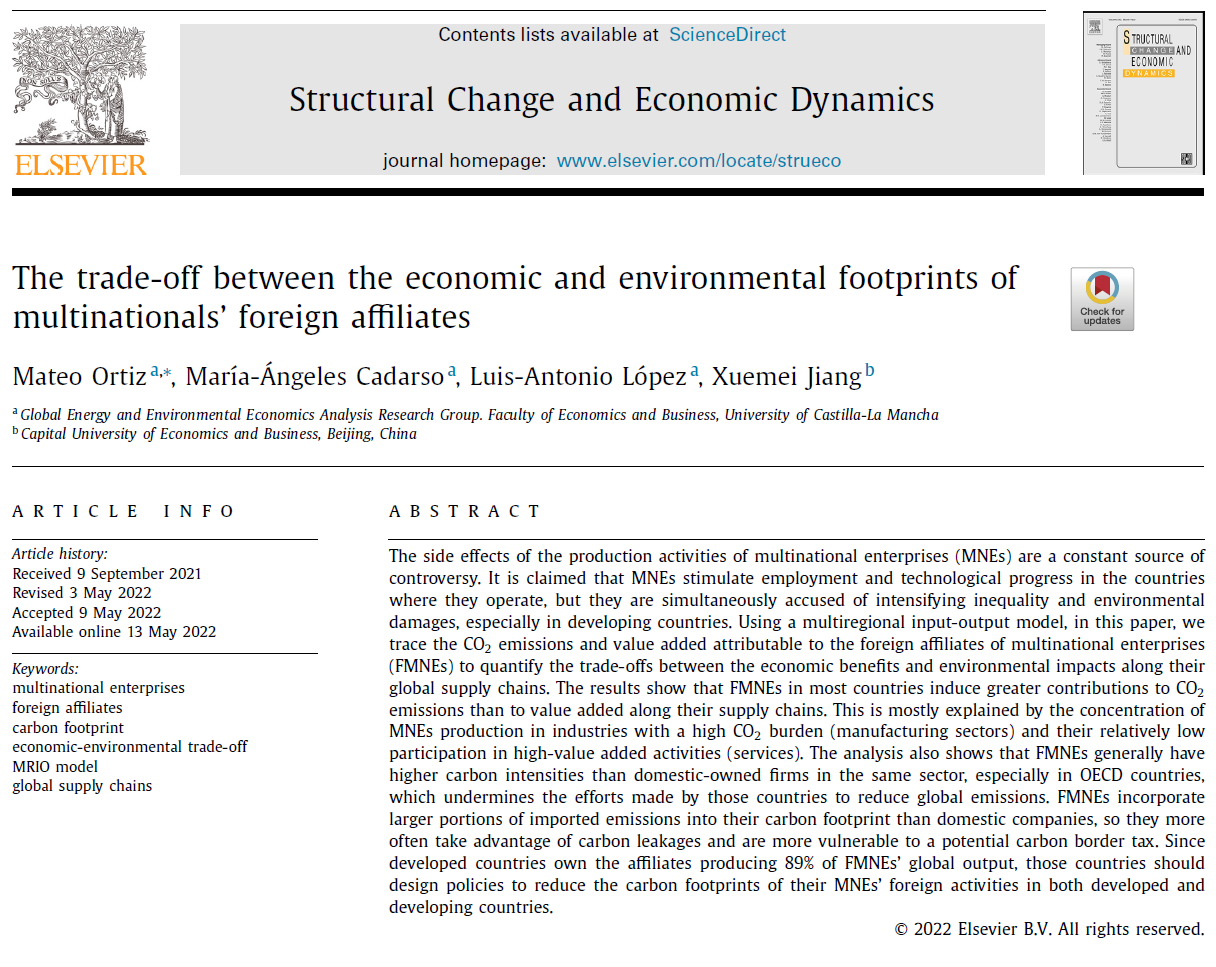
GEAR members Mateo Ortiz, Maria Ángeles Cadarso and Luis Antonio López achieve a new publication on the global supply chains of multinational enterprises, this time in collaboration with our colleague Xuemei Jiang of Capital University of Economics and Business (Beijing, China).

In the paper entitled “The trade-off between the economic and environmental footprints of multinationals’ foreign affiliates”, the authors trace the CO2 emissions and value added generated along the global supply chains of multinationals and quantify the trade-offs between their economic benefits and environmental impacts. They found that value added and ownership are concentrated in developed countries, while CO2 emissions are mostly released in developing countries.

The article also provides comparisons between the economic-environmental performance of multinationals and domestic-owned companies. In this respect, it finds that foreign affiliates in OECD countries show higher CO2 intensities and carbon leakages than the domestic firms in the same countries.

We strongly encourage you to read this great article on a very interesting topic. We hope you like it!

Link: https://doi.org/10.1016/j.strueco.2022.05.005