How does climate‑related migration reshape Bangladesh’s economic structure and employment? Marina Sánchez‑Serrano, Jorge Zafrilla, Guadalupe Arce and Ángela García‑Alaminos examine this question in their new article published in iScience (2026).
The article, titled «Socioeconomic impacts of climate-related migration: The case of Bangladesh», examines how slow-onset climate events that drive population displacement reshape Bangladesh’s economic structure. Using an environmentally extended input–output model based on the Miyazawa approach, the authors differentiate between rural and urban households to capture changes in consumption patterns and their propagation throughout the economy.
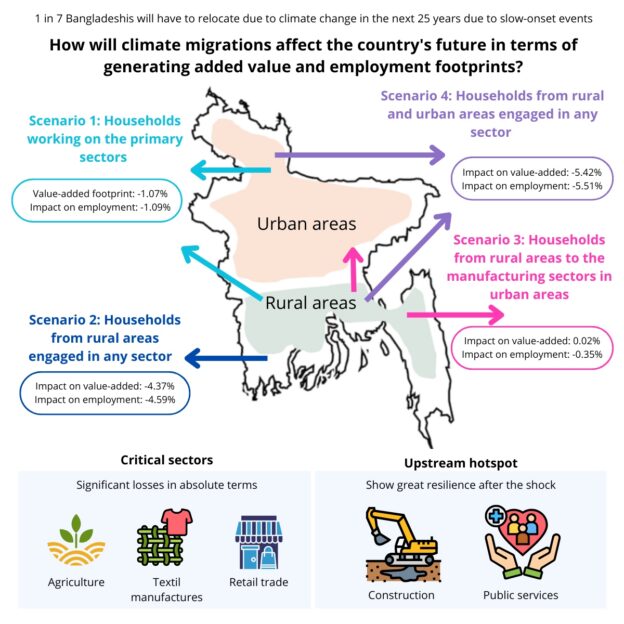
The study finds that climate-induced migration can lead to substantial socioeconomic losses. Depending on the scenario analysed, national value-added could fall by up to 5.4 percent and employment by up to 5.5 percent. The most vulnerable sectors are agriculture and fishing, construction, trade, transport, and public administration, all of which are tightly interconnected with the rest of the production system. The strong forward and backward linkages of these sectors amplify the impacts of population loss across the entire economy.
The results also show that the decline in rural population significantly reduces domestic demand, deepening the contraction in several key sectors. Non-industrial activities such as education and public administration experience particularly sharp induced declines, not because of direct production shocks but because of their high dependence on household consumption. In contrast, a scenario of internal migration—from rural areas to urban manufacturing—slightly expands industrial activity. However, this reallocation of labour increases the pressure on already overcrowded and environmentally stressed urban centres, raising concerns about urban sustainability.
Overall, the findings emphasise that climate-induced migration is not merely a demographic phenomenon: it restructures economies. In Bangladesh, addressing these challenges requires stronger industrial diversification, investment in climate-resilient infrastructure, and international financial support to mitigate the socioeconomic consequences. The study offers essential insights for researchers and policymakers working on climate economics, migration, and development. The full article is available at: https://doi.org/10.1016/j.isci.2026.115199