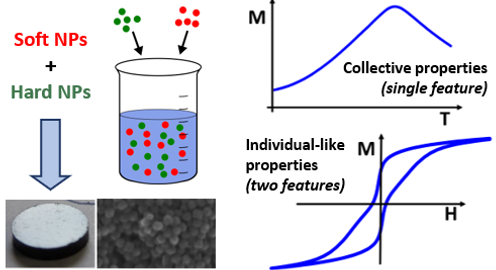
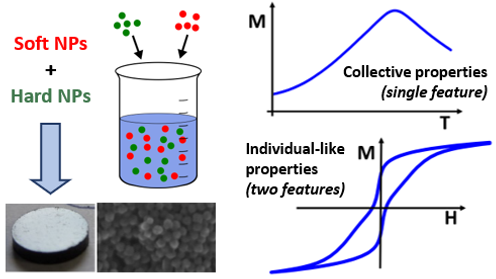
The journal Chemistry of Materials has just accepted for publication our study (in collaboration with long-term collaborators) on the magnetism of random binary compacts comprising two uniformly mixed populations of soft and hard nanoparticles (preprint here). It turns out that the answer we have found for the question above is «it depends where!», as we inform directly in the title of the paper: «Simultaneous individual and dipolar collective properties in binary assemblies of magnetic nanoparticles». We have shown how compact mixtures may be employed as a tool to test or, rather, to define the collective character of a given magnetic property as that resulting in the collapse of the individual features caused by strong enough interactions. Crucially, such collective character must, in general, be ascribed to specific properties and not to the system as a whole.
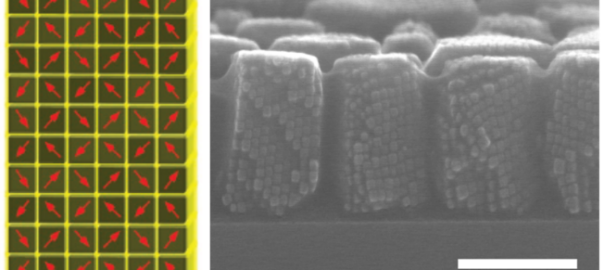
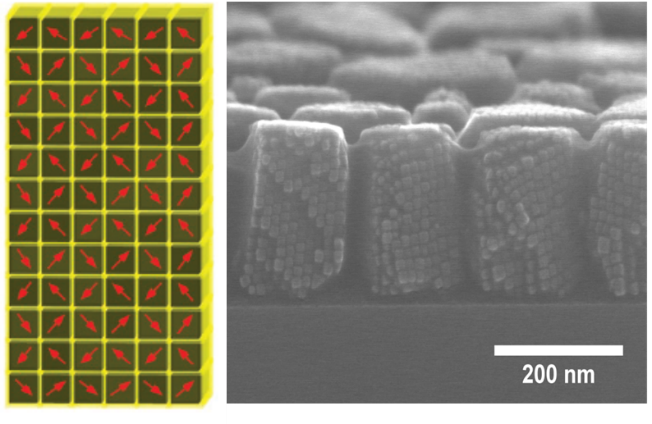
The ApNano group has taken part, in collaboration with researchers from the Norwegian University of Science and Technology and from the University of Sydney, in an investigation of magnetically enhanced mechanical stability in self-assembled nanostructures. The results, which have just been published in Advanced Functional Materials, combine Monte Carlo simulations, magnetic characterization and electronic microscopy to conclude a significant increase in cohesive energy from the magnetostatic interactions between magnetite nanocubes assembled in dense superstructures. This increase depends strongly on the size of the assembly. The discovery of this effect opens new possibilities in size-controlled tuning of superstructure properties, thus contributing to the design of next-generation self-assembled materials with simultaneous enhancement of magnetic and mechanical properties.
Chiara Olla (University of Cagliari) and Francesca Airaldi (University of Genoa) just left us after spending three months in our lab as Erasmus+ trainees. Both will next defend their Master degrees projects with new data and training in magnetometry and X-ray diffraction. We learnt with Chiara about the magnetism and structure of luminescent carbon dots doped with gadolinium synthesized in a mesoporous silica matrix, whereas Francesca studied
magnetic properties of different bi-magnetic core/shell ferrite nanoparticles. Both will pursue PhD studies back in Italy, best of luck with it!
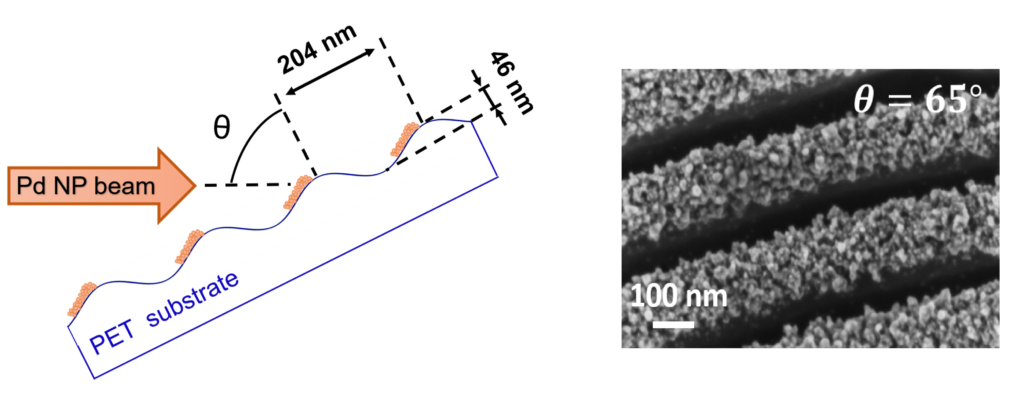
In collaboration with Instituto Rocasolano (CSIC, Madrid), who provided laser-irradiated undulated polymer substrates, we have succeeded in the preparation of nanoparticle stripes by self-shadowing deposition of gas-aggregated Pd particles. This novel type of nanostructure, with promising anisotropic properties, was one of the main objectives of our ongoing national project. The synthesis procedure, as well as optical, electrical and hydrogen-detection properties, have been submitted to the journal Applied Surface Science.
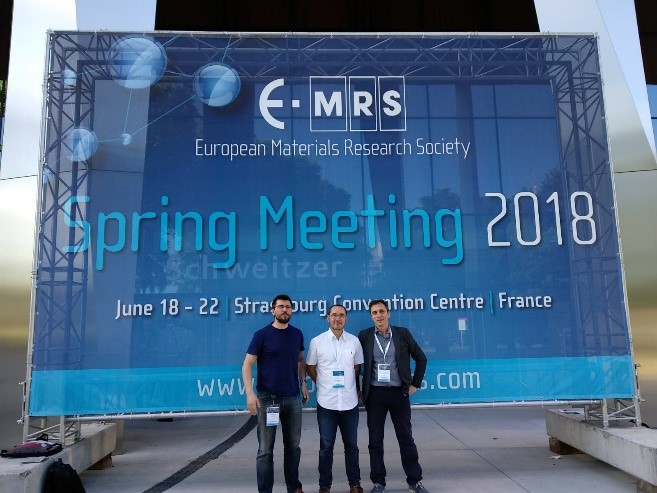
Esta semana se celebra en Estrasburgo el E-MRS Spring Meeting, con unos 3000 ponentes distribuidos en 28 simposios. Uno de ellos, titulado “Sustitución y Reciclado de Materias Primas Críticas en Dispositivos Optoelectrónicos, Magnéticos y para Energía”, ha sido organizado por los profesores José Ángel De Toro (del Applied Nanomagnetism Group, ApNano, en el Instituto Regional de Investigación Científica Aplicada, IRICA, de Ciudad Real), Carlo Ricci (Universidad de Cagliari) y Patrice Miska (Universidad de Lorraine).
Desde 2011 la Comisión Europea (CE) publica cada tres años una relación de materiales críticos para la industria europea evaluando, de un lado, la relevancia tecnológica de las diferentes materias primas (excluidos los combustibles) y, de otro, el riesgo de suministro, a su vez determinado por la abundancia y concentración geopolítica de los materiales. Por ejemplo, en la última revisión de la CE (enlace), los elementos de la familia de las tierras raras –cruciales, entre otras aplicaciones, en los motores de coches eléctricos y en generadores eólicos- fueron evaluados como los de mayor riesgo de suministro, ya que China controla el 95% de la producción mundial. Las tierras raras han encontrado gran eco mediático recientemente en nuestra comunidad debido a la controversia sobre la posible extracción de monacita en el Campo de Montiel. Una de las líneas del ApNANO busca precisamente reducir el uso de tierras raras en nanocomposites magnéticos (proyecto NANOESENS, financiado por el MICINN).
El simposio reúne más de 100 contribuciones de investigadores de 30 países, con presencia destacada de Italia, Corea del Sur y España. Entre ellas caben destacar los seminarios a cargo del Director del Instituto Europeo de Tecnología en Materias Primas (EIT Raw Materials), Didier Zimmerman, y de la asociación Enterprises pour la Environment (EpE), que gestiona los intereses mediambientales para las grandes empresas en Francia.
Los organizadores del simposio en sustitución de materiales críticos, que se celebra actualmente en el marco del congreso anual de la Sociedad Europea de Materiales
Massimiliano Murgia, a graduate student from University of Cagliari, stayed in our labs working as an Erasmus+ traineeship from March to June. He got hands-on experience on SQUID magnetometry, X-ray diffraction and gas-phase synthesis of nanoparticles. He is heading back to UNICA to pursue his Master studies. Good luck Massi, we hope to see you soon back in La Mancha as a PhD student.
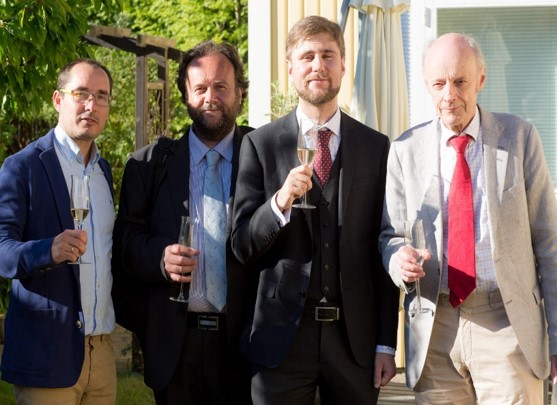
Mikael spent two research stays with us in 2014 and 2015 studying superspin glass behavior in random nanoparticle compacts (+ riding the hills in the Guadiana riverside). His thesis was co-supervised by Per Nordblad, Roland Mathieu and Jose A. De Toro, all in the picture. He now intends to pursue a postdoc career in neutron scattering. Congratulations, Mikael!
Elena has been hired with funds from the national NANOESENS projects. She will pursue a doctoral degree on the topic of novel magnetic nanostructures by working alternate years in our IRICA and INAMOL labs. Welcome to La Mancha, Elena!