
The project is proposed based on the results obtained in the previous TecnoCRA project. Therefore, the main purpose of this project is to integrate technological advances in the classroom in a natural way, so that they facilitate the educational work of teachers and improve the learning experience of students, taking into account the particularities of the Gathered Rural Schools (CRA).
In order to achieve this, the project has a twofold purpose. Firstly, to advance scientific and technical knowledge in the research field internationally known as TEL (Technology-Enhanced Learning). In this sense, the aim is to improve the results obtained previously, providing, on the one hand, new advances in the field of affective computing and integrating intelligent gamification mechanisms that improve the interactive experience of the system, through the creation of a robust infrastructure based on Fog Computing with IoT technology, which also allows the integration of new sensors, providing mobility, and interacting with the system in a natural way through minimally invasive wearable devices and interaction based on natural interfaces.
The second aim of the project will be to apply this knowledge in the educational field of two of the Gathered Rural Schools (CRA) existing in Castilla-La Mancha, specifically in the CRA «Sierra de Alcaraz» located in the province of Albacete and comprising the sections of Jardín, Peñascosa, Povedilla, Viveros and Robledo and, secondly, the CRA «Camino de Aníbal» comprising the municipalities of Lezuza, Tiriez and El Ballestero.
«The applications to be developed will provide support for teaching activities in these CRAs, both for teacher coordination and for the active participation of parents and students, emphasising interaction and communication between all educational agents.»
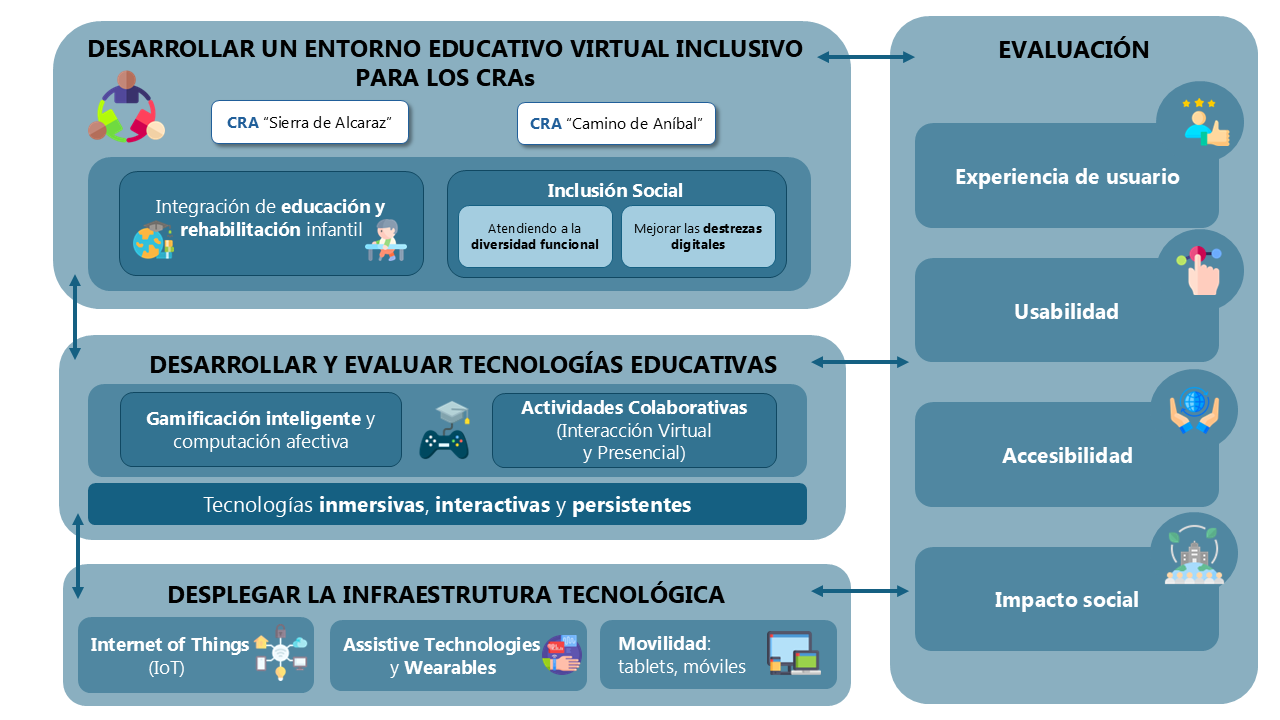
The evaluations to be carried out cover several areas, as not only an evaluation of the applications developed from an operational and usability point of view is envisaged, but also an initial evaluation of the socio-economic impact in those regions of Castilla-La Mancha declared as an ITI area.
Finally, among the results of the project we may expect to obtain advances in:
- IoT technology and wearable devices applied in educational environments;
- the Fog Computing paradigm, as an information management platform;
- the field of natural user interfaces;
- the field of gamification in educational environments;
- the incorporation of intelligent tutoring systems (ITS);
- the application of affective computing in the classroom;
- the generation and evaluation of prototypes to improve teaching activities, and finally,
- advances in the field of evaluation methods of the quality of use and user experience in educational environments enriched with technology.