Increasing digitalization has transformed educational and social environments, creating new opportunities to improve quality of life and equitable access to knowledge. However, these opportunities do not reach rural communities with the same intensity, where limitations in infrastructure, human resources, and connectivity hinder the adoption of advanced technologies. In Castilla-La Mancha, these challenges are reinforced by population dispersion, rural socioeconomic conditions, and depopulation.
In response, the research group has developed a TEL-based research line through TecnoCRA, InteCRA, and now ImpacCRA. This trajectory has improved the educational experience in rural clustered schools (CRAs) while generating scientific and technical advances in gamification, affective computing, and the use of IoT devices and wearables in education. The results of the previous projects, especially the collaborative virtual school, provide the basis for this new stage.
ImpacCRA aims to extend these advances in two specific settings: the CRA «Sierra de Alcaraz» (Peñascosa, Povedilla, Viveros, and Robledo) and the CRA «Camino de Aníbal» (Lezuza, Tiriez, and El Ballestero). The project seeks to improve the inclusion of children with functional diversity through collaborative activities and to strengthen the digital capabilities of teachers, students, and families. Expected results include advances in assistive technologies, intelligent gamification, affective computing, IoT and wearables, natural user interfaces, physical and cognitive stimulation, and quality-of-use and user-experience evaluation in TEL environments.
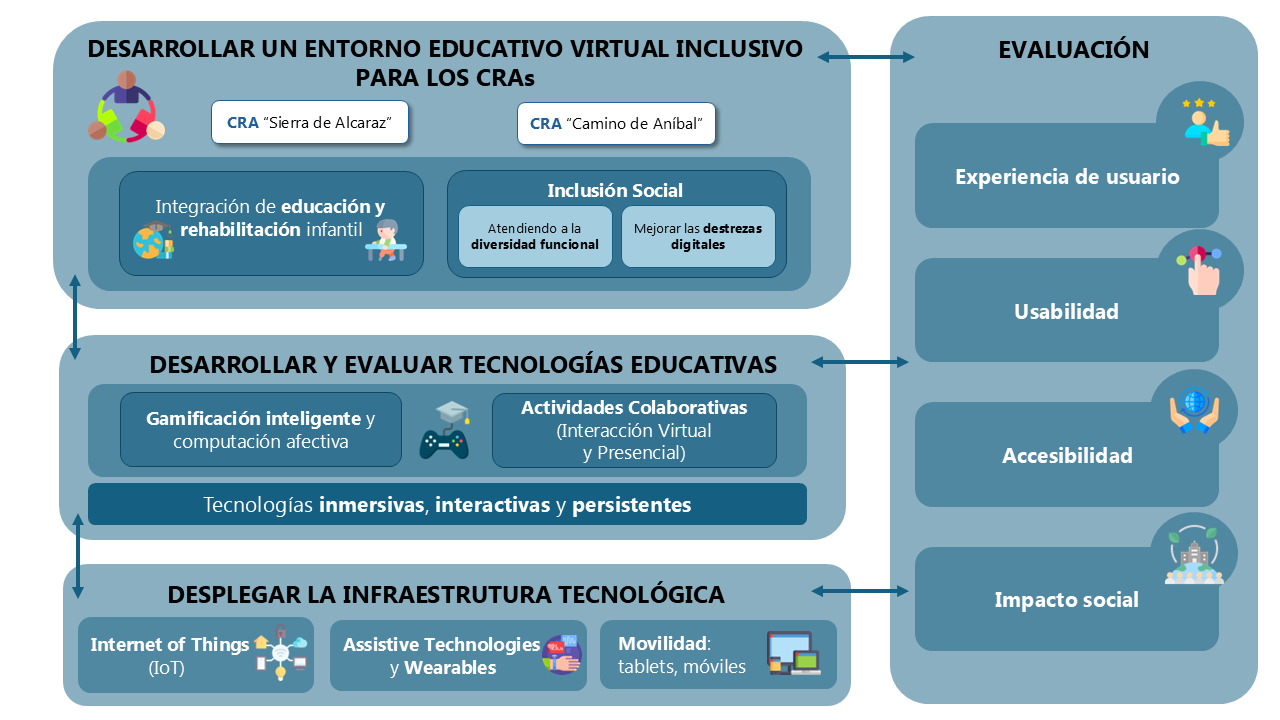
The evaluations will consider several dimensions. In addition to assessing the developed systems from an operational and usability perspective, the project will also evaluate their impact in terms of the degree of inclusion of students with functional diversity and the degree of improvement in the digital capabilities of the three educational agents involved.
Among the expected results of the project are advances in:
- assistive technologies in educational environments;
- the application of affective computing in the classroom;
- IoT technologies and wearable devices;
- gamification in educational environments;
- natural user interfaces;
- physical and cognitive monitoring and stimulation; and
- methods for evaluating quality of use and user experience in Technology-Enhanced Learning environments.