
Archivo del Autor: JAVIER ENRIQUE DIAZ VERA

Two in three state secondary schools in England teach just one foreign language

(https://www.theguardian.com/education/2023/jun/29/two-in-three-state-secondary-schools-in-england-teach-just-one-foreign-language)

The Guardian reports that two-thirds of state secondary schools in England now offer only one foreign language to all pupils at Key Stage 3 (11–14). German is the biggest casualty of this contraction: it is taught in barely a third of state schools. Meanwhile independent schools still maintain a wider linguistic repertoire. Teacher shortages, underfunding, and a long feedback-loop of low take-up → less provision → even lower take-up seem to be driving the squeeze. The UK government has launched new “Language Hubs” to try to reverse the trend, but the scale looks small compared to the structural slide.

Seen in a post-Brexit frame, the picture is even more ironic. Brexit was rhetorically framed as a way to “go global”; logically, that should have made more multilingual competence essential. But the schooling data suggest the opposite dynamic: a shrinking linguistic horizon, a kind of quiet monolingualisation inside the very society that now needs multiple linguistic bridges to navigate non-automatic international mobility.

In the EU, English still functions as lingua franca; but in England, plurilingual capacity is weakening. That divergence is one of the most curious symptoms of the post-Brexit era: Europe remains structurally multilingual, but England is increasingly socially structured for “one foreign language is enough”. For language education, policy, translation/localisation professions and future intercultural labour markets, this is not a trivial development. It is a structural one — and it will shape who can actually participate globally, beyond slogans.

What do you think is driving this? Is this a temporary post-Covid teacher-shortage artefact — or a deeper shift in how England imagines languages? And is Brexit pushing the UK towards the world economically — or away from its languages?
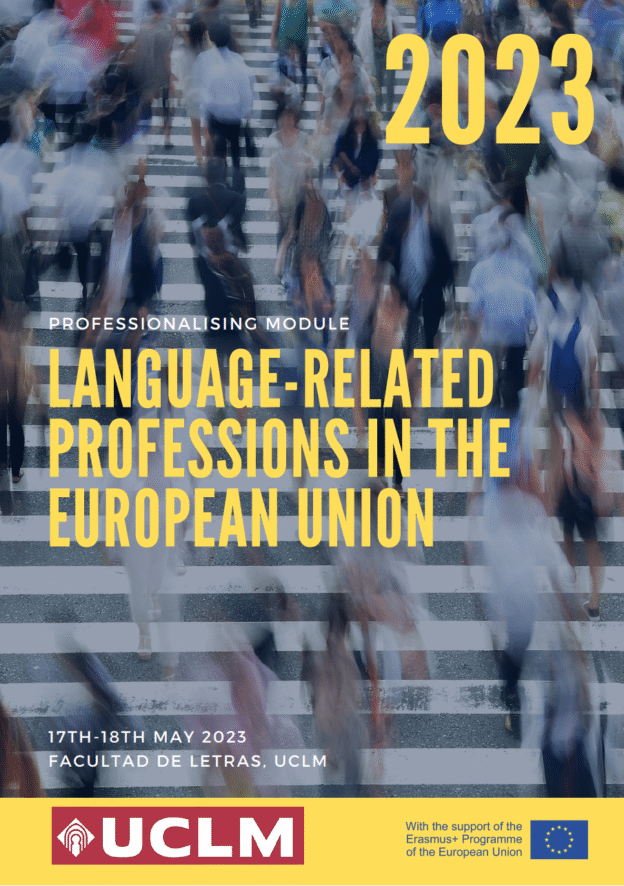
Welcome to the professionalising module “Intercultural Management within the EU Context”

This 3-hour professionalising module introduces students of Humanities to concrete career pathways in European multilingual labour markets (especially in translation, subtitling, localisation, cultural mediation and identity-oriented European Studies).

The focus is practical and workplace-based: how multilingual repertoires, intercultural competence and identity work operate in real EU institutional, cultural and communication settings.

The 2023 edition opens a window onto forensic linguistics in multilingual Europe: many authorship, threat, online discourse or disinformation cases today involve more than one language. Here, multilingual knowledge does not simply describe the context, it becomes an analytic tool.

Together with additional courses, conferences, seminars and project deliverables coordinated by the Jean Monnet Chair, this short module maps how intercultural management + multilingualism = professional added value in contemporary EU contexts.

More information and enrollment available from cursosweb.

More Irish-language news from Brussels

Following the language’s new full official + working status in the EU, The Irish Times reports that Irish-speakers are suddenly in demand, not only in Luxembourg and Brussels, but even in recruitment campaigns based in Greece. It’s a real example of how language status becomes labour-market reality almost instantly: jobs don’t just symbolically recognise multilingualism: they begin to require it.

Full article here:
https://www.irishtimes.com/news/world/europe/irish-speakers-in-demand-in-brussels-and-even-in-sunny-greece-1.4769658

There will be more to say about all this; but for now, it’s simply exciting to see multilingual identity + policy shifts translating straight into professional openings in Europe.

Big multilingualism milestone alert!

Irish has finally become a fully official and working language of the European Union, which means that from now on Irish gets translated like any other EU language, not just in a limited / derogated sense. It’s a major symbolic moment and a very practical one: Irish is now truly sitting at the same table as the rest.

If you want the story straight from a trusted newspaper, here is the piece:

Irish gains full official and working status in the EU
https://www.irishtimes.com/news/ireland/irish-news/irish-gains-full-official-and-working-status-in-the-eu-1.4767303

This is the kind of real-world case we love to talk about: identity, recognition, language rights, and the sometimes slow but real institutional change in Brussels.

And yes: you can already imagine the consequences in translation, terminology, subtitling, authorship, recruitment, training, digital resources, etc.

Short version: multilingual Europe just got a tiny bit more multilingual.

El español reclama su lugar en la ciencia y la tecnología

(https://elpais.com/tecnologia/2022-12-04/el-idioma-espanol-en-la-ciencia-y-la-tecnologia.html)

An article published on 4 Dec 2022 in El País highlights how Spanish-speaking countries are mobilising to change the long-standing dominance of English in science and tech. The piece reports that Spain is leading a €1.1 billion public investment (via the strategic plan “Alianza por la Nueva Economía de la Lengua”) to promote Spanish and co-official languages in five key areas: knowledge production in Spanish, AI in Spanish, science in Spanish, learning in Spanish, and cultural & creative industries. The article also emphasises how although Spanish is the second most frequent language in scientific output, its visibility is still very low: almost all high-impact experimental science is published in English (or increasingly Chinese). Spanish remains overrepresented in humanities, social sciences and medical fields, but less so in lab-based disciplines. It also stresses that linguistic inclusion in digital technologies is a matter of both justice and economic opportunity: if Spanish is left out of the AI, cloud and translation ecosystem, the gap with English and other major languages will widen.

This is a timely piece that speaks directly to our interests in multilingualism, identity and language policy. A few reflections.

  • The move to treat Spanish (and by extension other less-dominant languages) as strategic assets in science & tech is refreshing. It shifts the narrative from “we must learn English” to “our languages also have value and deserve representation”.
  • It’s interesting to see how the article links language to economics and technology: not only: culture and identity, but also market share, AI datasets and international competitiveness. That gives the language-policy issue more traction.
  • Yet, the structural dominance of English remains huge in experimental science. As the piece says: 99% of the publications from top research centres in Spain still go through English. That means the transformation will require long-term commitment, not just funding.
  • For our work in translation/localisation and in language education: this suggests a growing field of opportunity. If Spanish becomes more embedded in AI, data, tech production, there will be demand for terminological expertise, multilingual corpora, machine-learning in Spanish, etc.
  • One caveat: the article doesn’t go deeply into how languages other than Spanish (e.g., co-official languages in Spain, regional identities) will fit. It mentions them, but the operational implications are less clear.
  • Finally, from a European-multilingualism perspective: this case shows that even large global languages (Spanish) can feel “minor” in the tech/science ecosystems. So for truly minor or regional languages the challenge is even steeper — but the logic remains: visibility, presence and capacity in technology/digital matter more than ever.

In conclusion, the Spanish-language science & tech ecosystem is at a turning point. The push here offers both a symbolic and practical shift in language policy. For anyone working on language education, translation, multilingual tech or European language policy, this is worth watching. Not only the ‘what’ (spanish = asset) but the ‘how’ (investment, digital tech, terminologies) will matter.

Let me know what you think: Do you see opportunities in your field maybe changing because of this? Or perhaps comparators in other European languages you know?

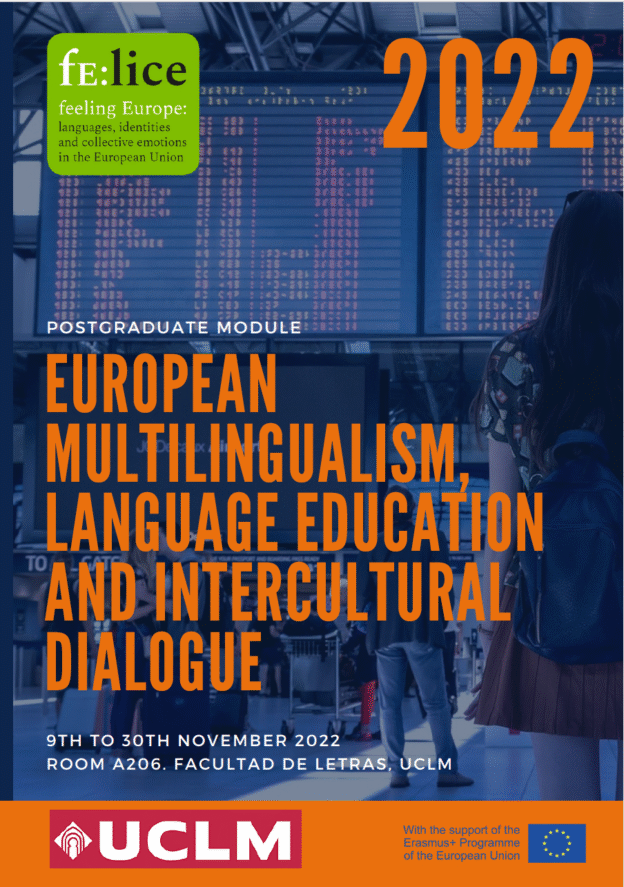
Welcome to the first edition of the Jean Monnet postgraduate module “European Multilingualism, Language Education and Intercultural Dialogue.”

We are delighted to announce the new edition of the Jean Monnet postgraduate module European Multilingualism, Language Education and Intercultural Dialogue — a space designed to discuss how multilingual repertoires, education systems, and language policies intersect across the European Union.

This 2022 postgraduate module will take place from 9th November to 30th November 2022 in Room A206, Facultad de Letras (UCLM), and consists of 24 hours (1 ECTS).
Teaching will be delivered by:

  • Weeks 1–2: Prof. Javier E. Díaz Vera
  • Week 3: Prof. Rosario Caballero
  • Week 4: Prof. Ana María Relaño Pastor

This module connects empirical case studies, policy analysis and comparative reflection: exploring multilingualism both as a social reality and as a field of advanced research.

Programme (16:00–19:00 every day):

9–10 November — Language policies and planning in the European Union
16–17 November — Multilingualism in contemporary Europe
23–24 November — Multilingualism and cultural dialogue in the EU
30 November -1st December — Trends in policies and practices in European multilingualism

Registration is available at www.cursosweb.uclm.es

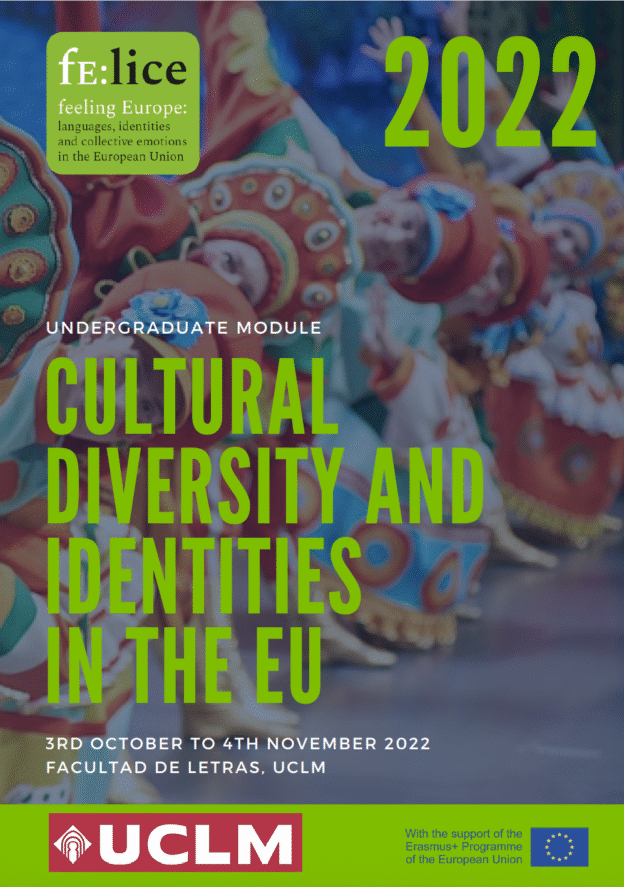
Welcome to the first edition of the Jean Monnet undergraduate module “Cultural Diversity and Identities in the European Union”

Welcome to the first edition of the Jean Monnet undergraduate module “Cultural Diversity and Identities in the European Union.”

We are delighted to welcome you to a fresh edition of the undergraduate Jean Monnet module Cultural Diversity and Identities in the EU, a space for reflection, debate and research on the multilingual and multicultural reality of today’s European Union.

This edition will take place from 3rd October to 4th November 2022 in Room A206, Facultad de Letras (UCLM), and consists of 1 ECTS, delivered by Prof. Javier E. Díaz Vera.

As in previous years, our module explores the EU as a language hotspot: a continent where national, regional, immigrant and endangered languages coexist, overlap, compete and evolve. Throughout the programme we will move from concepts, to empirical reality, to policy, to research trends. The 2022 programme includes topics of Multilingualism in contemporary Europe, European multilingualism and the diversity debate, Trends in policies and practices in European multilingualism, Regional and immigrant languages in the European Union, Endangered languages in the European Union, and Multiculturality and multilingualism in the EU as a new field of research.

Once again, we will analyse multilingualism not only as a sociolinguistic phenomenon, but as a political, educational, economic, identity and cultural resource: and a field of research in rapid expansion.

Enrolment is available at: www.cursosweb.uclm.es