Archivo del Autor: JAVIER ENRIQUE DIAZ VERA

Welcome to the third edition of the professionalising module “Intercultural Management within the EU Context”

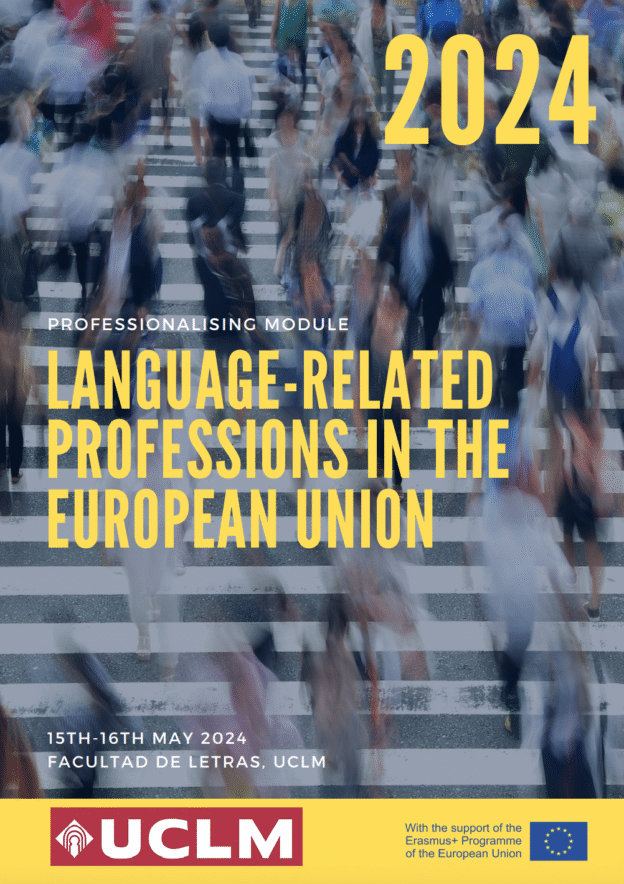
This 3-hour professionalising module introduces students of Humanities to concrete career pathways in European multilingual labour markets (especially in translation, subtitling, localisation, cultural mediation and identity-oriented European Studies).

The focus is practical and workplace-based: how multilingual repertoires, intercultural competence and identity work operate in real EU institutional, cultural and communication settings.

The 2024 edition opens a window onto forensic linguistics in multilingual Europe: many authorship, threat, online discourse or disinformation cases today involve more than one language. Here, multilingual knowledge does not simply describe the context, it becomes an analytic tool.

Together with additional courses, conferences, seminars and project deliverables coordinated by the Jean Monnet Chair, this short module maps how intercultural management + multilingualism = professional added value in contemporary EU contexts.

More info and enrollments from cursosweb.

The difficult process of learning to “speak the language of power”

https://www.eeas.europa.eu/eeas/difficult-process-learning-speak-language-power_en (Servicio Europeo de Acción Exterior)


In a 29 November 2024 blog post, former EU High Representative Josep Borrell reflects on his five-year mandate and argues that the European Union must learn to “speak the language of power” if it is to defend its interests effectively in a more dangerous and multipolar world. He notes that while the EU has strong institutions and normative power, it too often lags in agility, coherence and strategic action. (Servicio Europeo de Acción Exterior)
Though the article is about geopolitics and power, it touches on language in a metaphorical but meaningful way—and links to our interest in multilingualism in several ways:

  • The notion of “speaking the language of power” reminds us that language is not only a matter of communication, but also of agency, representation and influence. Multilingualism matters because if you cannot “speak the language” of institutions, you may be excluded from decision-making, from representation, or from the ability to shape policy.
  • In the context of EU multilingualism, this implies that having many languages (and the capacity to use them) is not merely symbolic: it is part of the infrastructure of power, legitimacy and participation. Member states and citizens whose languages and voices are less present may find themselves outside the circles of influence.
  • For professional fields (translation, localisation, language policy, multilingual education): if the EU is to strengthen its voice globally, the language-skills ecosystem inside the EU (including translation/interpreting, multilingual education, language technology) must be robust. Multilingual professionals become part of the “language of power” the EU needs.
  • The article also indirectly raises questions about resource allocation, institutional structures, and how multilingual practices are embedded in governance. If the EU wants to act with power, the behind-the-scenes language infrastructure (translation, interpretation, multilingual staff, digital multilingual systems) must align with that ambition.
  • Finally, from a policy-perspective: there is a gap between rhetoric (“Europe should speak with one strategic voice”) and practice (“member states still operate in 24+ languages, institutional delays, translation burdens”). Bridging that gap requires foresight, investment and professionalisation—precisely the domains our modules explore.
  1. What do you interpret by “speaking the language of power” in the context of European institutions? Is it literal (languages, translation) or metaphorical (strategic discourse, influence)?
  2. In what ways does multilingualism enhance or hinder an institution’s power and agility? Could fewer languages be more efficient? Or is multilingualism itself a strategic asset?
  3. If you were designing a professional-training module for multilingual staff in the EU (translation/localisation/education), what skills would you prioritise to ensure that Europe can “speak the language of power”?

Would love to hear your take!

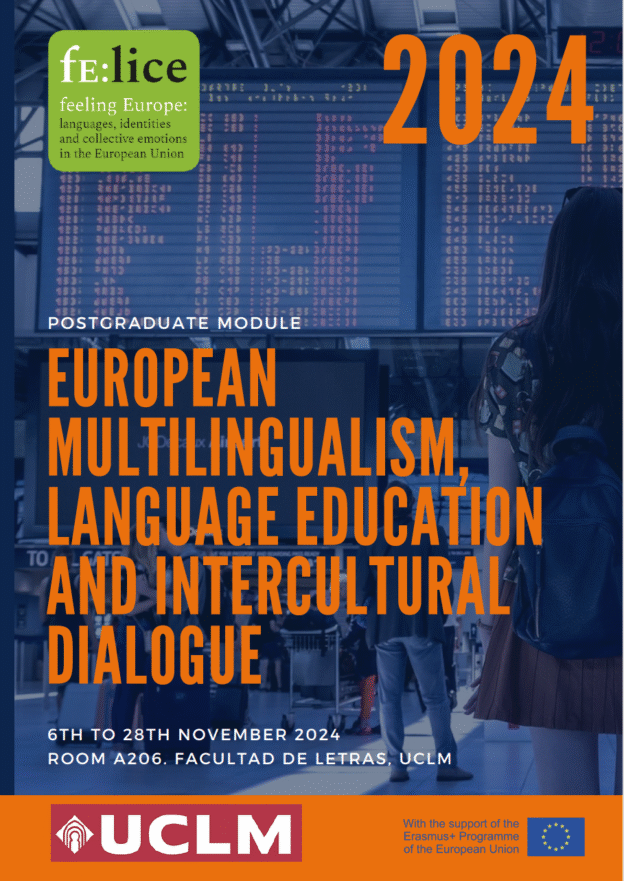
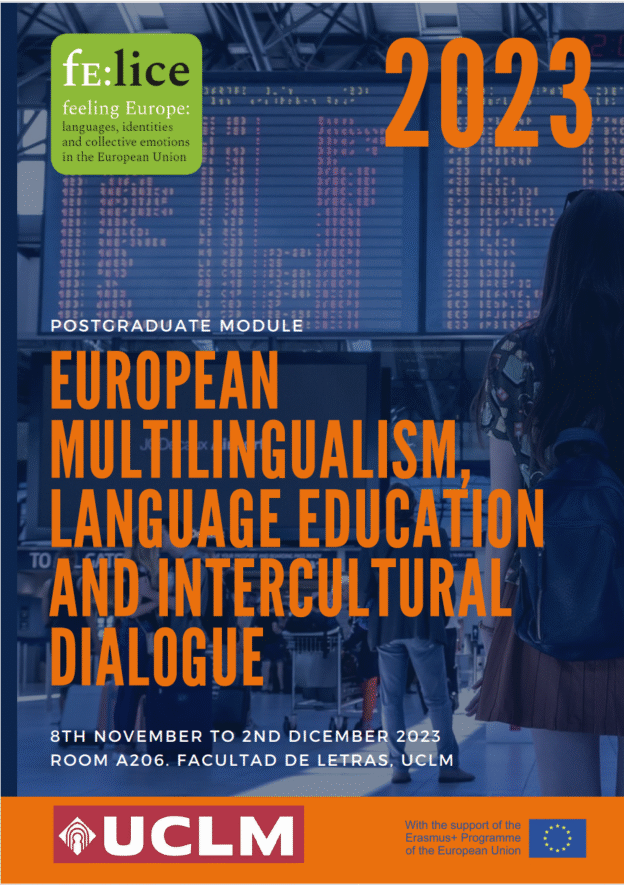
Welcome to the third edition of the Jean Monnet postgraduate module “European Multilingualism, Language Education and Intercultural Dialogue.”

We are delighted to announce the new edition of the Jean Monnet postgraduate module European Multilingualism, Language Education and Intercultural Dialogue, a space designed to discuss how multilingual repertoires, education systems, and language policies intersect across the European Union.

This 2024 postgraduate module will take place from 6th to 28th November 2024 in Room A206, Facultad de Letras (UCLM), and consists of 24 hours (1 ECTS).
Teaching will be delivered by:

  • Weeks 1–2: Prof. Javier E. Díaz Vera
  • Week 3: Prof. Rosario Caballero
  • Week 4: Prof. Ana María Relaño Pastor

Like every year, this module connects empirical case studies, policy analysis and comparative reflection — exploring multilingualism both as a social reality and as a field of advanced research.

Programme (16:00–19:00 every day):

6–7 November — Language policies and planning in the European Union
13–14 November — Multilingualism in contemporary Europe
20–21 November — Multilingualism and cultural dialogue in the EU
27-28 November — Trends in policies and practices in European multilingualism

Registration is available at www.cursosweb.uclm.es

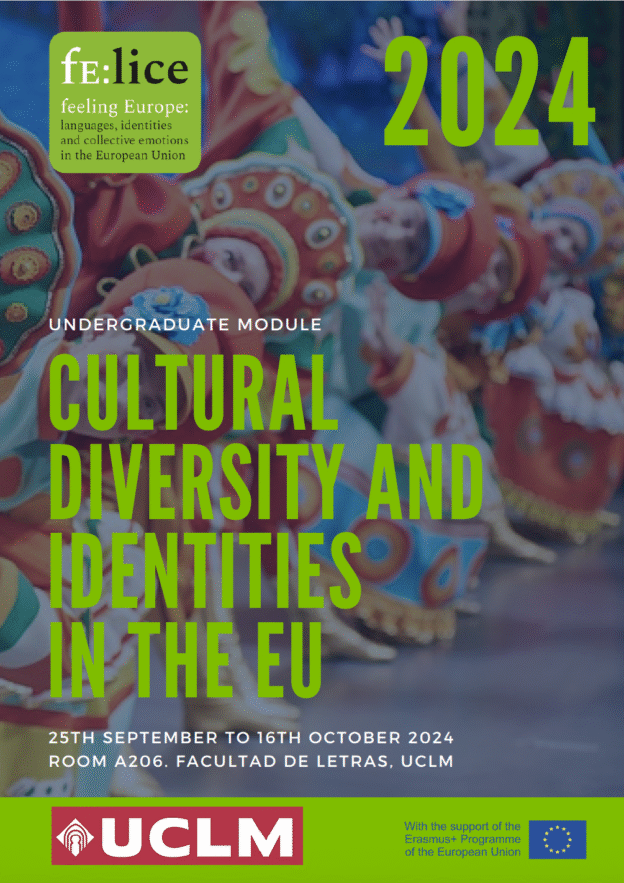
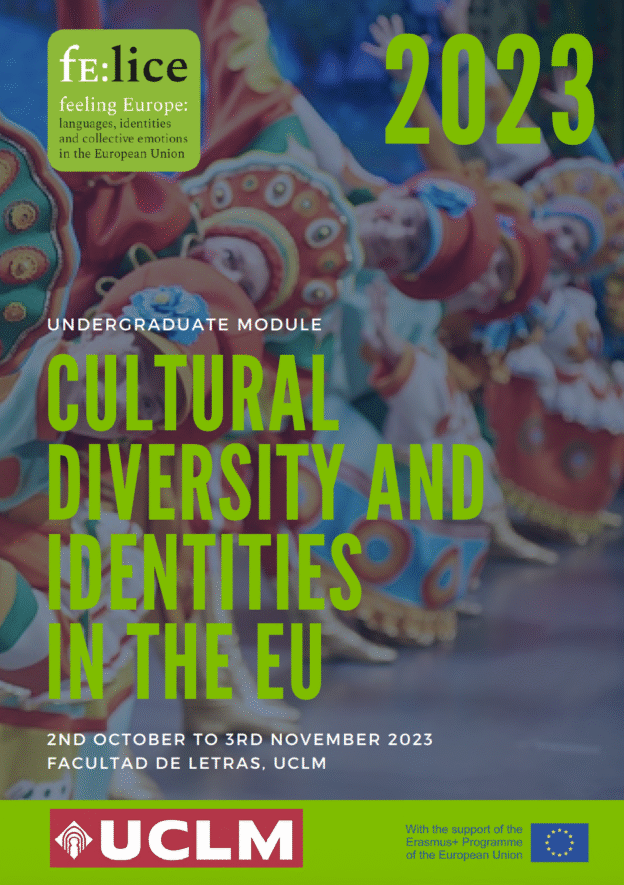
Welcome to the third edition of the Jean Monnet undergraduate module “Cultural Diversity and Identities in the European Union”

Welcome to a new edition of the Jean Monnet undergraduate module “Cultural Diversity and Identities in the European Union.”

We are delighted to welcome you to a fresh edition of the undergraduate Jean Monnet module Cultural Diversity and Identities in the EU, a space for reflection, debate and research on the multilingual and multicultural reality of today’s European Union.

This edition will take place from 25th September to 16th October 2024 in Room A204, Facultad de Letras (UCLM), and consists of 1 ECTS, delivered by Prof. Javier E. Díaz Vera.

As in previous years, our module explores the EU as a language hotspot: a continent where national, regional, immigrant and endangered languages coexist, overlap, compete and evolve. Throughout the programme we will move from concepts, to empirical reality, to policy, to research trends. The 2024 programme includes topics of Multilingualism in contemporary Europe, European multilingualism and the diversity debate, Trends in policies and practices in European multilingualism, Regional and immigrant languages in the European Union, Endangered languages in the European Union, and Multiculturality and multilingualism in the EU as a new field of research.

Once again, we will analyse multilingualism not only as a sociolinguistic phenomenon, but as a political, educational, economic, identity and cultural resource: and a field of research in rapid expansion.

Enrolment is available at: www.cursosweb.uclm.es

Welcome to the professionalising module “Intercultural Management within the EU Context”

This 3-hour professionalising module introduces students of Humanities to concrete career pathways in European multilingual labour markets (especially in translation, subtitling, localisation, cultural mediation and identity-oriented European Studies).

The focus is practical and workplace-based: how multilingual repertoires, intercultural competence and identity work operate in real EU institutional, cultural and communication settings.

The 2024 edition opens a window onto forensic linguistics in multilingual Europe: many authorship, threat, online discourse or disinformation cases today involve more than one language. Here, multilingual knowledge does not simply describe the context, it becomes an analytic tool.

Together with additional courses, conferences, seminars and project deliverables coordinated by the Jean Monnet Chair, this short module maps how intercultural management + multilingualism = professional added value in contemporary EU contexts.

More info and enrollments from cursosweb.

Welcome to the second edition of the Jean Monnet postgraduate module “European Multilingualism, Language Education and Intercultural Dialogue”

We are delighted to announce the new edition of the Jean Monnet postgraduate module European Multilingualism, Language Education and Intercultural Dialogue — a space designed to discuss how multilingual repertoires, education systems, and language policies intersect across the European Union.

This 2023 postgraduate module will take place from 8th to 2nd December 2023 in Room A206, Facultad de Letras (UCLM), and consists of 24 hours (1 ECTS).
Teaching will be delivered by:

  • Weeks 1–2: Prof. Javier E. Díaz Vera
  • Week 3: Prof. Rosario Caballero
  • Week 4: Prof. Ana María Relaño Pastor

Like every year, this module connects empirical case studies, policy analysis and comparative reflection: exploring multilingualism both as a social reality and as a field of advanced research.

Programme (16:00–19:00 every day):

10–11 November — Language policies and planning in the European Union
17–18 November — Multilingualism in contemporary Europe
24–25 November — Multilingualism and cultural dialogue in the EU
1-2 December — Trends in policies and practices in European multilingualism

Registration is available at www.cursosweb.uclm.es

Welcome to the second edition of the Jean Monnet undergraduate module “Cultural Diversity and Identities in the European Union”

Welcome to a new edition of the Jean Monnet undergraduate module “Cultural Diversity and Identities in the European Union.”

We are delighted to welcome you to a fresh edition of the undergraduate Jean Monnet module Cultural Diversity and Identities in the EU, a space for reflection, debate and research on the multilingual and multicultural reality of today’s European Union.

This edition will take place from 2nd October to 3rd November 2023 in Room A204, Facultad de Letras (UCLM), and consists of 1 ECTS, delivered by Prof. Javier E. Díaz Vera.

As in previous years, our module explores the EU as a language hotspot: a continent where national, regional, immigrant and endangered languages coexist, overlap, compete and evolve. Throughout the programme we will move from concepts, to empirical reality, to policy, to research trends. The 2023 programme includes topics of Multilingualism in contemporary Europe, European multilingualism and the diversity debate, Trends in policies and practices in European multilingualism, Regional and immigrant languages in the European Union, Endangered languages in the European Union, and Multiculturality and multilingualism in the EU as a new field of research.

Once again, we will analyse multilingualism not only as a sociolinguistic phenomenon, but as a political, educational, economic, identity and cultural resource: and a field of research in rapid expansion.

Enrolment is available at: www.cursosweb.uclm.es

Spain grants Basque, Catalan and Galician languages parliamentary status

(https://www.theguardian.com/world/2023/sep/19/spain-grants-basque-catalan-and-galician-languages-parliamentary-status)

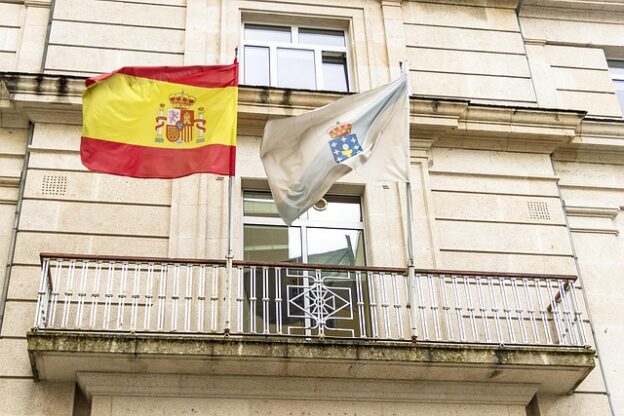
On 19 September 2023, Spain’s national parliament approved a reform allowing MPs to speak in the regional languages Basque, Catalan and Galician during debates — alongside Spanish. The change was part of a deal by the caretaker government to secure support from Catalan and Basque-region parties following an inconclusive election. The reform came with the promise of translation and interpretation systems. Some opposition parties, including the far-right, walked out in protest. The article notes that Spain continues to push these languages for recognition at EU level, yet faces resistance from other Member States over costs and precedent.
This is a noteworthy shift: from regional co-official languages being used locally and in autonomous community institutions to being formally recognised at the national legislative level. It signals a step in the “normalisation” of these languages in Spain’s public and political life.

From a European multilingualism viewpoint, a few aspects stand out:

  • The move reflects the institutional recognition of linguistic diversity within a state: by enabling Basque, Catalan and Galician in national parliament, Spain is acknowledging that Spanish alone does not suffice for the full political representation of its multilingual society.
  • However, the bump-up from national to EU level is yet uncertain: Spain is also pushing for these languages to become official in the European Union, but as the article shows others are wary. This illustrates the gap between “recognition in national law” and “recognition in supranational institutions”.
  • From the perspective of translation, localisation and language professions: if these languages gain more institutional recognition (national + EU), then the demand for high-quality translation, interpreting, terminological corpora and multilingual digital services will grow. The fact that Spain promises to fund translation costs adds a concrete professional dimension: the shift is not purely symbolic.
  • There is also the risk of precedent effects: as countries grant greater status to regional/minority languages, the institutional costs (translation, interpreting, published materials, digital services) mount. Other EU states and institutions are sensitive to this.
  • Politically, the change is entangled with power-sharing deals and party support. That means language recognition is not only cultural/educational, but deeply political. Recognition can follow negotiation leverage, rather than pure linguistic rights logic.
  1. What do you make of the idea that regional languages like Basque, Catalan and Galician are being empowered at national level? Does this strengthen or fragment national cohesion in your view?
  2. If these languages were recognised at EU level, what professional or educational opportunities (translation, localisation, terminology, digital services) might open up — and what obstacles might appear?
  3. Do you think recognition of languages in institutions should be driven by speaker numbers, historic use, identity politics, or economic/technical viability? Which criteria matter the most?

Would love to hear your perspectives!

España se ofrece a pagar los costes de hacer oficial en la UE el catalán, el euskera y el gallego

(https://elpais.com/espana/2023-09-15/negociaciones-de-investidura-y-formacion-de-gobierno-en-directo.html)

On 15 September 2023, El País reported that Spain announced its willingness to assume the translation and interpretation costs required for recognising three of its co-official languages—Catalan, Basque (Euskera) and Galician—as official languages of the European Union. This proposal was tabled ahead of a meeting of EU ministers (Council of General Affairs) in Brussels. However, more than half of the EU member states raised concerns in preparatory sessions: they asked for more time to examine the legal, procedural and budgetary implications of expanding the number of official languages (then 24) and were reluctant to risk setting a precedent that might trigger many similar demands across Europe.

This development is particularly interesting for several reasons:

First, it shows how linguistic recognition and politics are tightly bound: Spain not only asserted the cultural-political importance of its co-official languages, but offered to pay the associated cost. That turns a symbolic request into a concrete institutional one, raising the stakes.

Second, from a multilingual EU perspective, the proposal reveals the tension between identity/recognition and institutional practicality. Expanding official languages means more translation, more interpretation, more administrative infrastructure—members rightly ask: where does it stop? Which languages qualify? How many? The fact that several countries prefer to delay rather than deny shows the complexity.

Third, for professional fields linked to translation, localisation and multilingual policy, this could be significant: if Catalan, Basque and Galician become official in the EU, we might expect growth in translation/localisation demand, terminological work, multilingual technologies tailored to those languages—especially given Spain’s willingness to carry the cost burden.

Finally, this case also acts as a mirror for lesser-used and regional languages elsewhere in Europe: if a large state like Spain puts forward this kind of proposal, what does it say about the prospects for other regional languages or minoritized languages? And how will EU institutions respond to the balance between linguistic diversity and administrative efficiency?

  • Would you support the recognition of Catalan, Basque and Galician as official EU languages if you were making the decision? Why or why not?
  • In your country or region, are there languages that could make a case for official EU status? What would be the barriers?
  • From a practical perspective, what do you think is the greatest obstacle to expanding official languages in the EU: cost, precedent-setting, technical resources, or something else?

Looking forward to your thoughts!
Les Vingt-Sept réticents à adopter le catalan, le basque et le galicien comme langues officielles de l’Union européenne

(https://www.lemonde.fr/international/article/2023/09/10/les-vingt-sept-reticents-a-adopter-le-catalan-le-basque-et-le-galicien-comme-langues-officielles-de-l-union-europeenne_6188672_3210.html)

On 10 September 2023, Le Monde reported that although the Spanish Prime Minister formally requested that Catalan, Basque and Galician be recognised as official languages of the European Union (which would raise the number of official EU languages beyond 24), the proposal faces major resistance from other Member States. Many fear this would open the door to a flurry of similar demands from other minority-language communities across Europe, as some states estimate that roughly 8 % of the EU population belongs to such minority-language groups. According to the piece, unanimity of the 27 is required to approve the change — yet that appears highly improbable given the political, financial and practical implications.

This article offers a revealing glance at how language, identity and power interplay within the EU’s framework. On one hand, the request by Spain underscores how belonging to a language community is not just about culture but about access, representation and institutional recognition. On the other, the resistance highlights how these requests trigger broader concerns: budgetary cost of translation & interpretation, precedent for other regions (e.g., Basque in France, Russian-speaking minorities in Eastern Europe), and the potential complexity of adding many more official languages.

From a multilingualism-in-Europe perspective, several points stand out:

  • Institutional recognition matters: Languages like Catalan, Basque, Galician already function socially and politically; but full “official and working” status in EU institutions would shift their visibility and resources.
  • Precedent risk: The resistance of Member States is partly grounded in fear of “opening the floodgates” — once you add three, what about dozens more? The logic of equality collides with institutional practicality.
  • Translation & cost implications: Making a language official in the EU entails more translations, interpreters, terminological work — these are real costs and resource issues, not only symbolic.
  • Power asymmetries in language politics: Even within multilingual states like Spain, some languages have stronger institutionalised status than others; but at EU level the playing field tilts heavily towards large languages or those already recognised.
  • Education, localization and professional implications: If these languages gained official status, we could expect shifts in translation/localisation demand, terminological work, multilingual digital resources and perhaps new job streams.

If you were a decision-maker in the EU, would you approve the inclusion of Catalan, Basque and Galician as official languages? Why or why not? How do you think this debate reflects on smaller languages in your country/region? In your view, what is the greatest barrier to recognising more languages at EU level: cost, precedent, political will, or something else?

Happy to hear your thoughts!